Sintered Stone Surfaces: Specifying for Hot Climates
Published: October 11, 2026
The surface that outlasts the sun: UV-stable, stain-proof, heat-tolerant and untouched by salt air. Slab sizes, thicknesses, the numbers behind the material and how we specify and ship it for hot-climate projects.
Marble stains, quartz yellows, timber moves. In the climates we supply — equatorial East Africa, the Gulf coast, humid West Africa — those three failures are not edge cases; they are the default. Sintered stone is the engineered answer: a fired-mineral slab with less than 0.1 percent water absorption, no resin to discolour and no sealing schedule to maintain. In our catalogue of 102,491 files across 74 categories it sits beside 1,422 tile files and 115 marble and granite files as the modern surface option, and it appears in more villa and hotel briefs every quarter. What it is, the numbers that matter, and how to specify it for heat, dust and salt air is the subject of this guide — a companion to Natural Stone for Hot Climates: Marble & Granite Guide.
1. What sintered stone is — and what it is not
Sintered stone is made from ground minerals — quartz, feldspar, silica and mineral pigments — pressed under tens of thousands of tons and sintered in kilns above 1,200 °C. The result is a fully vitrified body with no polymer content. That single fact drives every performance number in this guide: nothing in the slab can burn, melt, bleach or feed mould.
The family tree matters when you compare quotes. Porcelain tile is a close cousin — the same fired minerals, cut into smaller formats, as set out in Specifying Porcelain & Ceramic Tiles for Hot, Dusty Climates. Quartz surfaces share the mineral filler but carry 5 to 7 percent polymer resin, which is exactly what fails under sustained UV. Natural marble and granite are quarried, cut and — in marble’s case — sealed for life. The table below sets the four apart on the properties that decide a hot-climate installation.
| Property | Sintered stone | Granite (natural) | Quartz (engineered) | Marble (natural) |
|---|---|---|---|---|
| Body | Fired minerals, no resin | Quarried silica | ≈93% mineral + polymer resin | Quarried calcite |
| Water absorption | ≤0.1% | 0.1–0.4% | ≈0.1% | 0.2%+, seals required |
| UV stability | Stable | Stable | Resin yellows outdoors | Stable but etches |
| Heat | Thermal-shock resistant | Excellent | Scorches above ≈150 °C | Discolours |
| Mohs hardness | ≈6 | 6–7 | 5–6 | 3 |
| Maintenance | No sealing | Periodic sealing | None | Regular sealing |
2. The numbers that decide the specification
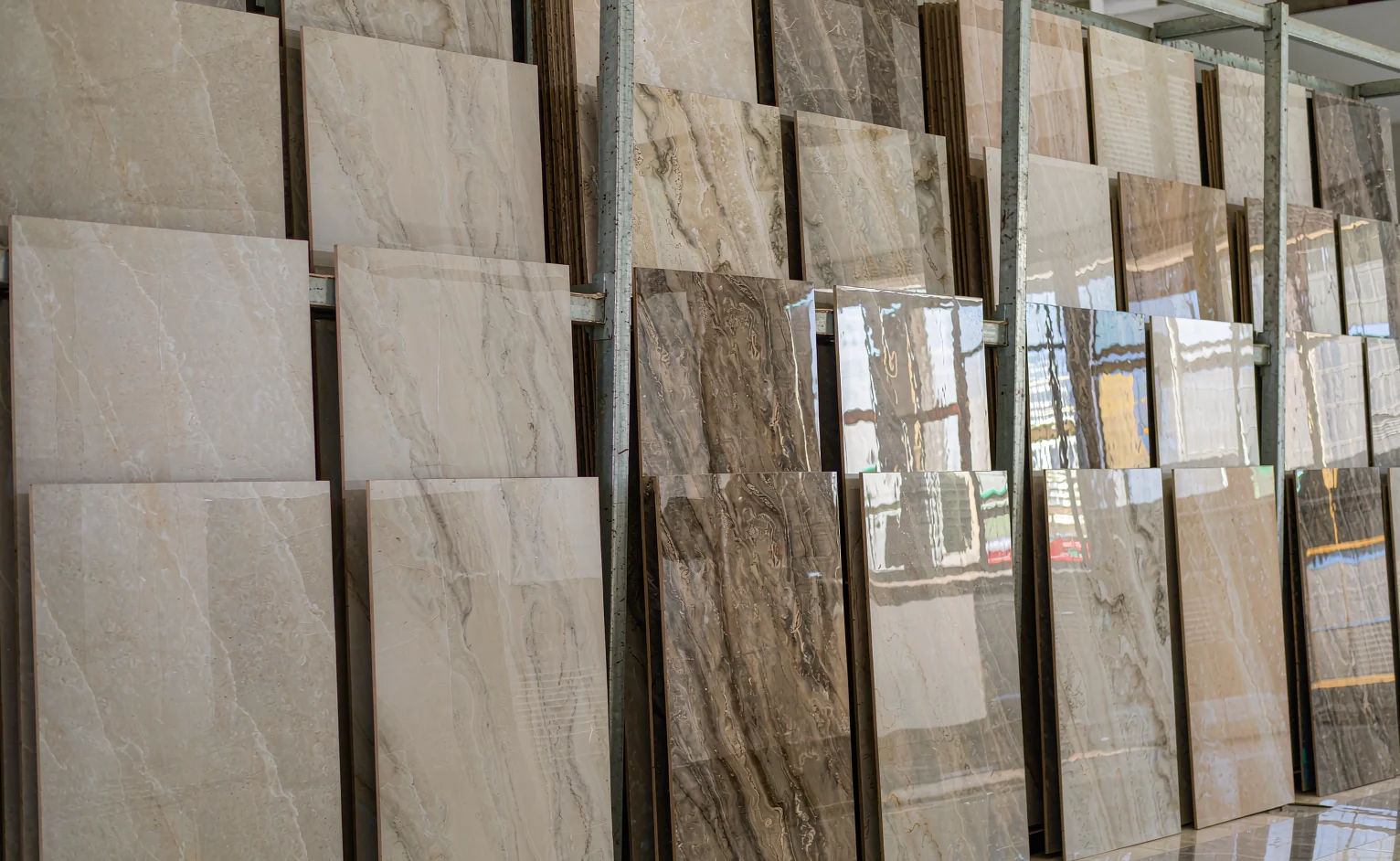
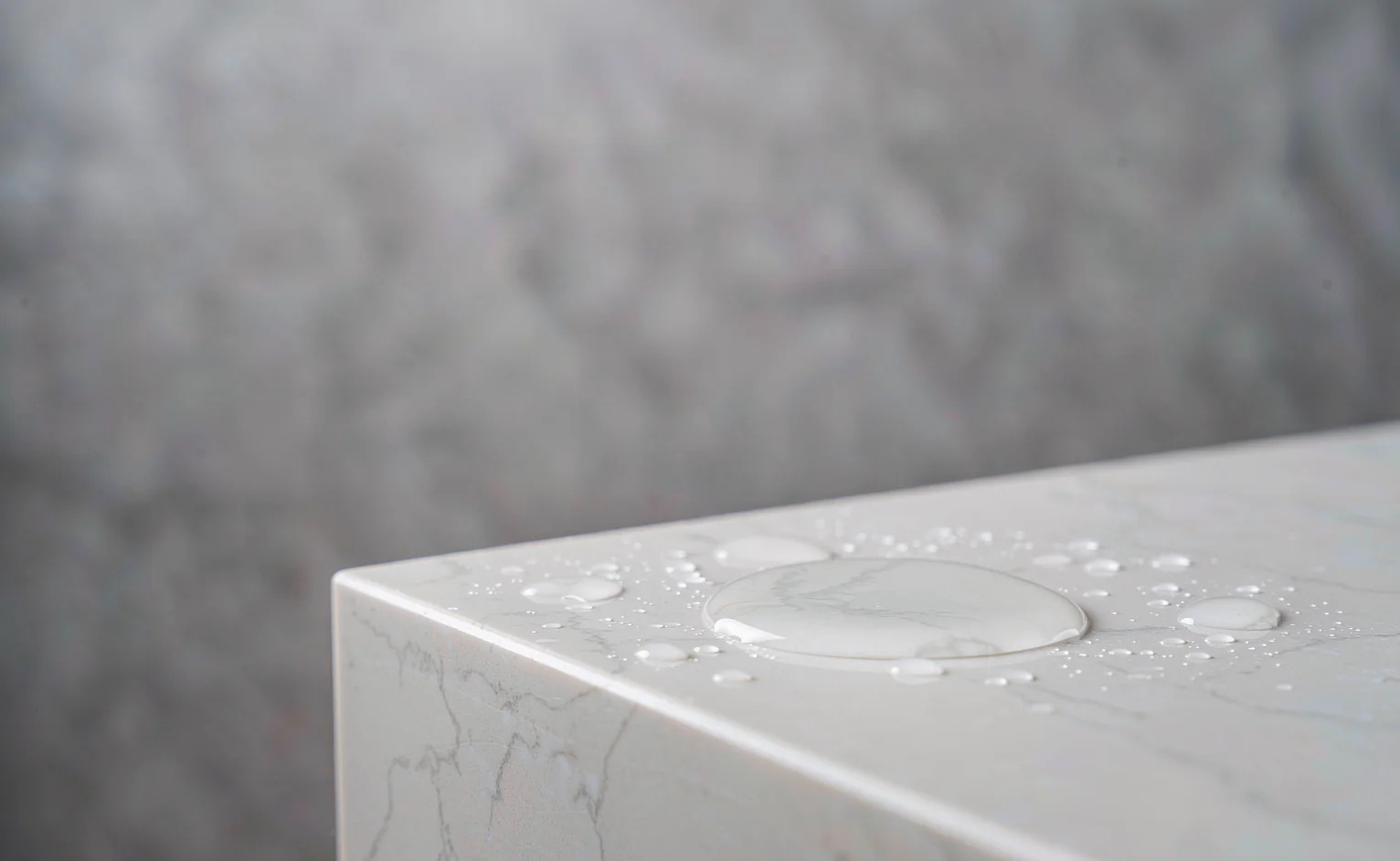
Four numbers carry the specification: format, thickness, absorption and weight. Slabs come in 1,600 × 3,200 mm, 1,200 × 2,400 mm and intermediate formats; thickness runs 6, 12 or 20 mm. Absorption is the headline: at 0.1 percent or less, coffee, turmeric, red wine and pool chemicals sit on the surface instead of wicking in — the property shown in the figure below. Weight is the freight number, and it scales linearly with thickness at a density near 2,400 kilograms per cubic metre.
| Thickness | Typical applications | Slab weight | Coverage per slab |
|---|---|---|---|
| 6 mm | Wall cladding, facade panels, wardrobe and furniture faces | ≈74 kg | 5.1 m² |
| 12 mm | Kitchen worktops, island tops, vanity tops, table tops | ≈148 kg | 5.1 m² |
| 20 mm | Pool coping, outdoor bars, exposed edges, high-traffic floors | ≈246 kg | 5.1 m² |
3. Where it wins in hot climates
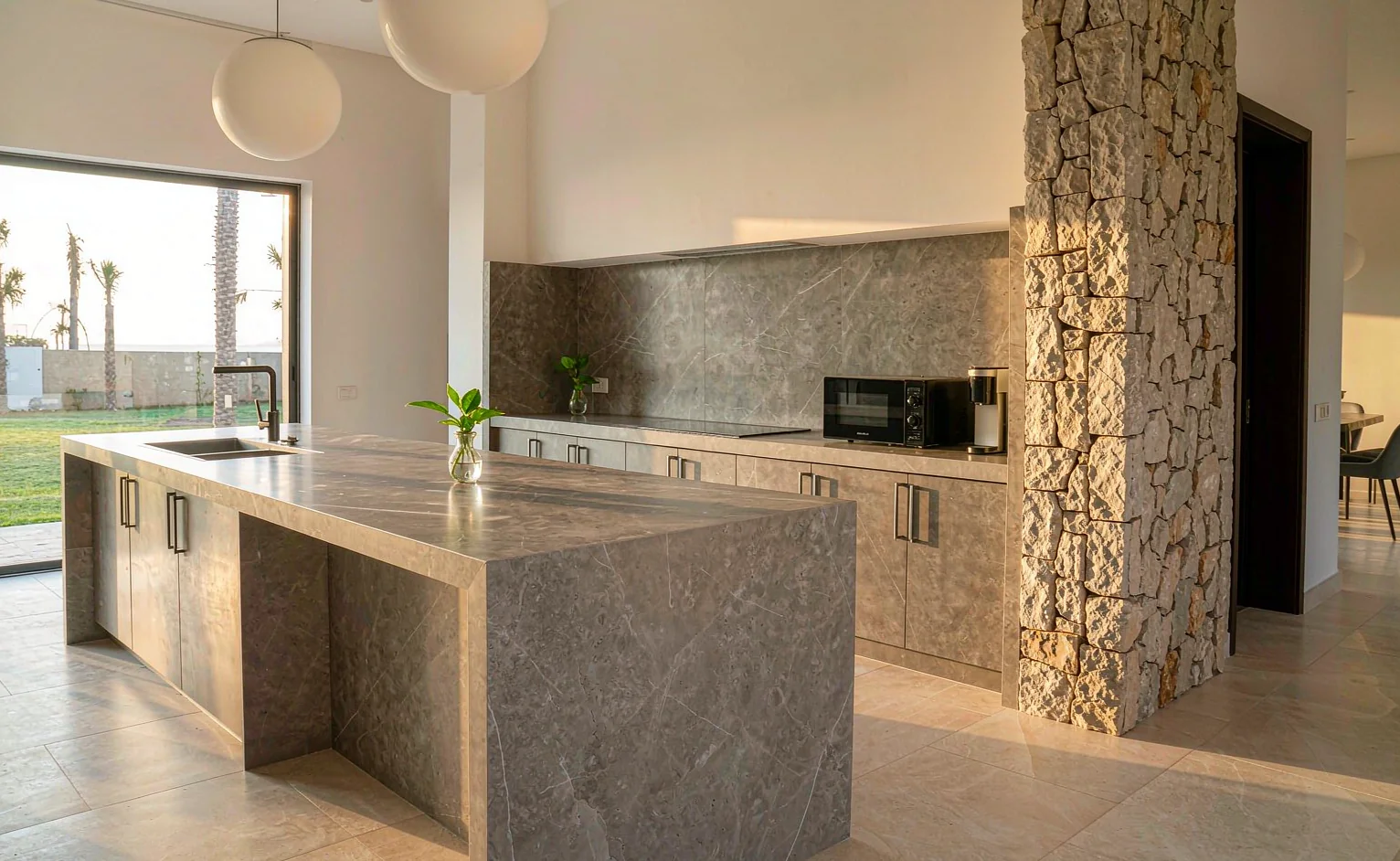
Kitchens. The worktop is the hardest-working surface in any villa brief. Sintered stone tolerates thermal shock, ignores turmeric and coffee, and the 12 mm slab lets a 3.2-metre island run without a joint. We pair it with the cabinet specifications in Kitchen & Cabinetry Materials Compared. Bathrooms are the quiet win: vanity tops and shower returns in 6 or 12 mm share the wet-area logic of our sanitary-ware guidance, documented in Specifying Sanitary Ware & Bathroom Fittings for Hot, Humid Climates.
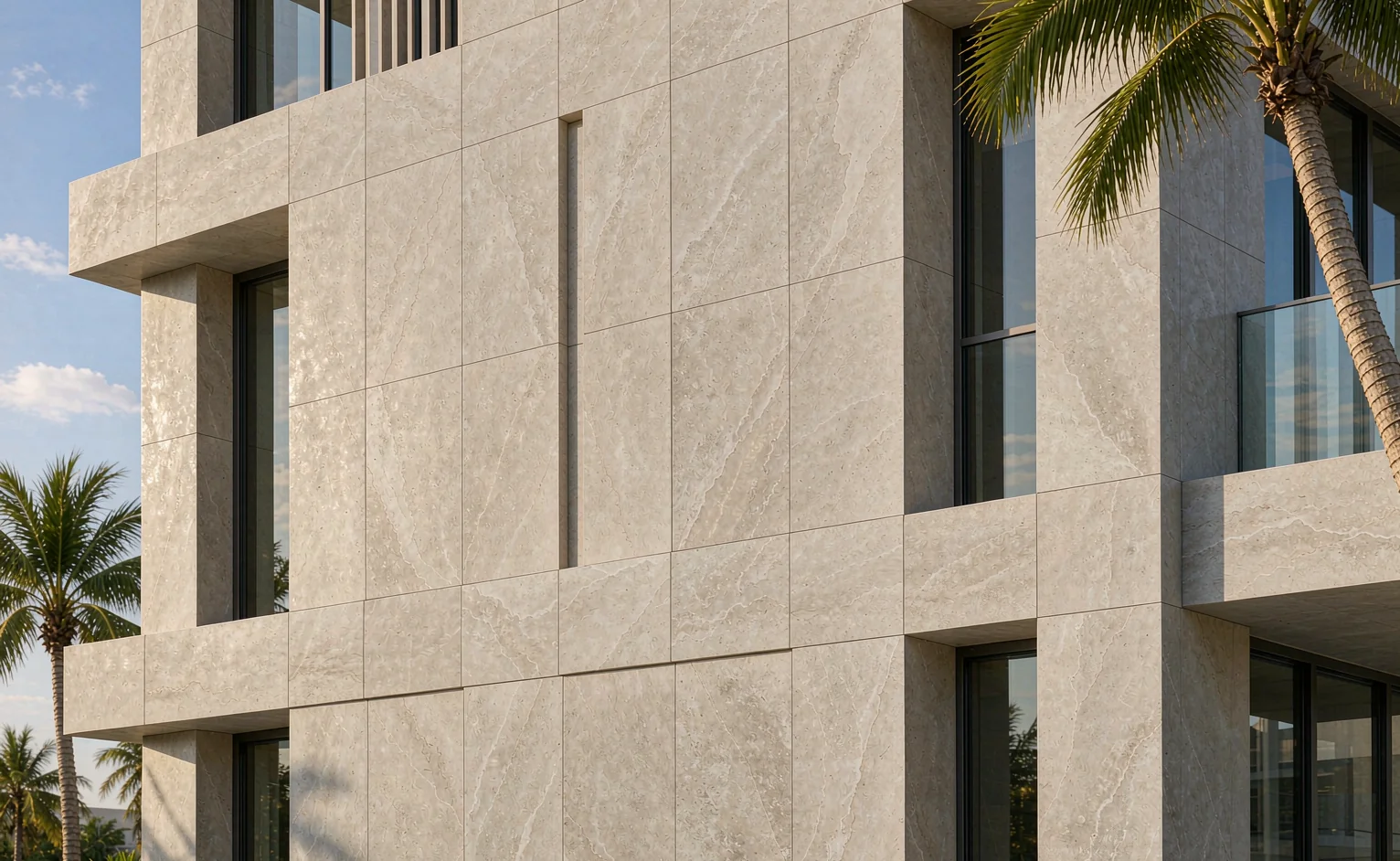
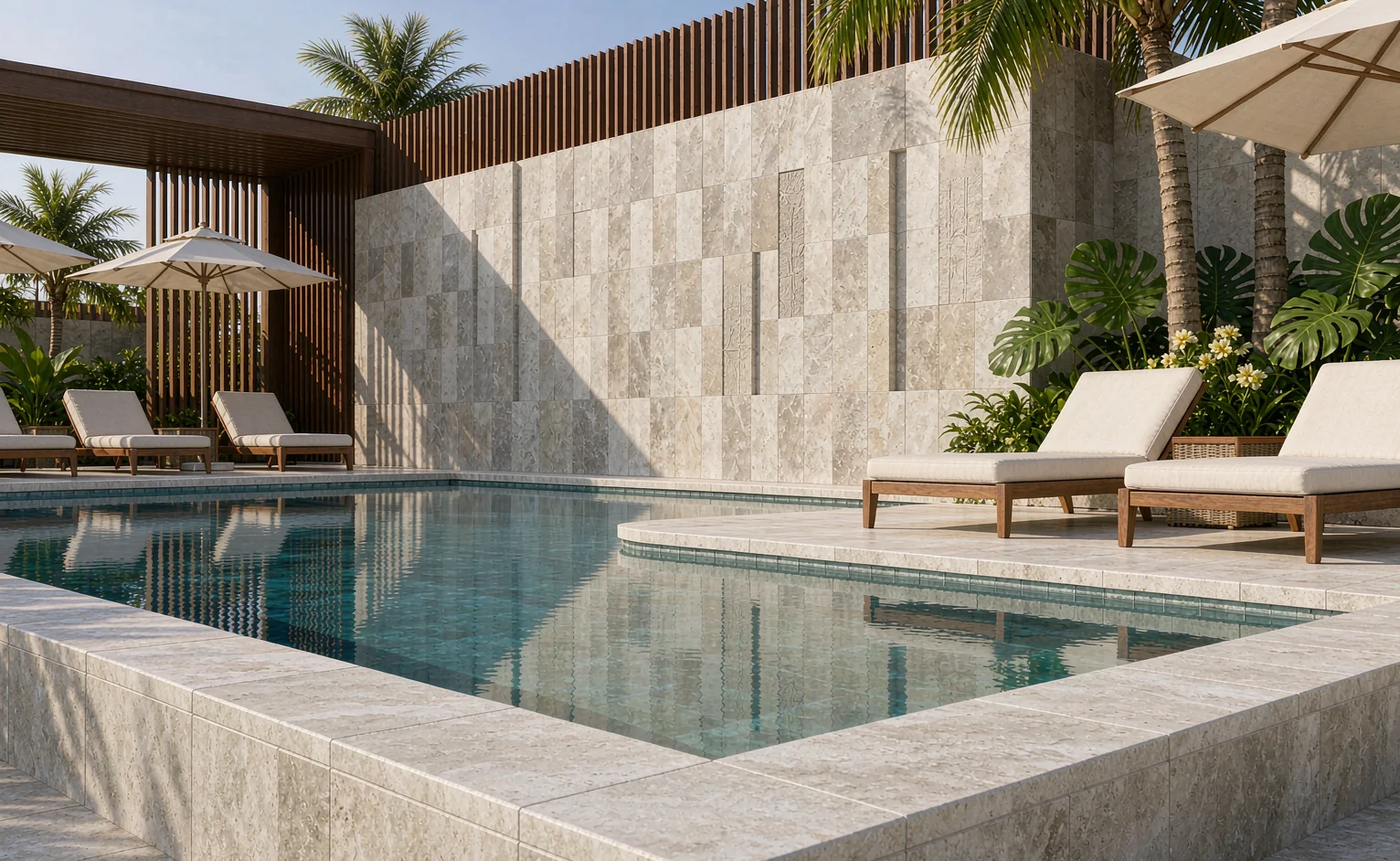
Facades and shaded outdoor rooms. Six-millimetre panels on a ventilated subframe take full equatorial sun without the resin-yellowing that rules quartz out, and the surface washes clean in the rain. Pool surrounds. Twenty-millimetre coping on a textured finish holds the slip rating while shrugging off chlorine and salt — the two chemicals that age most stone decks.
4. Specifying and shipping it in one order
In our file, sintered stone is rarely ordered alone. It rides with the tile, cabinet and sanitary-ware lines of the same villa or hotel package, and the catalogue behind it is the same 74-category, 102,491-file library that backs every order: 13 sintered-stone slab collections alongside 115 marble and granite files and 1,422 tile files, so a client can compare finishes across all three in one sitting — the way we assemble Whole-House Material Packages: What 63 Enquiries Ask For. The same slabs reappear as furniture tops, matching the material logic in Specifying Durable Furniture Materials for Hot-Climate Interiors.
Inspection before shipment matters more for slabs than for tiles. We check flatness on a level table, edge chips on all four sides, and colour consistency across the slabs allocated to one room, because a 3.2-metre island shows every variation. Slabs ship vertical in A-frame crates, edges protected, roughly 40 to 50 slabs per crate depending on thickness. At 12 mm, one slab covers 5.1 square metres and weighs about 148 kilograms, so a 40ft container carries 600 to 700 square metres of finished surface — enough for a large villa’s kitchen and wet areas in a single phase.
- Confirm the application and thickness: 6 mm cladding, 12 mm worktops, 20 mm coping and exposed edges.
- Allocate slabs per room from the same production batch, and record the vein direction for book-matched faces.
- Check flatness, edges and colour consistency before the slabs leave the warehouse, not after arrival.
- Book A-frame crates with edge protection at 40–50 slabs per crate, and verify the container weight at ≈148 kg per 12 mm slab.
- Consolidate slabs with the tile and sanitary-ware lines of the same phase, so wet areas close together.
Planning sintered stone for a hot-climate project?
Send the drawings, the city and the surfaces you have in mind — worktops, facades, pool coping or all three. You will get thickness recommendations per application, slabs batch-matched per room, and the material consolidated with the rest of your order.
Request a Sintered Stone Quotation →Frequently asked questions
What is sintered stone made of?
Sintered stone is made from ground minerals such as quartz, feldspar, silica and mineral pigments, compressed under tens of thousands of tons of pressure and sintered in kilns above 1,200 degrees Celsius. There is no polymer resin in the body, which is why it holds a Mohs hardness around 6, absorbs less than 0.1 percent water and never needs sealing. It belongs to the same fired-mineral family as porcelain tile, but is produced in slabs up to 1,600 by 3,200 millimetres, which is what makes jointless countertops and tall facade panels possible.
Is sintered stone better than granite or quartz for hot climates?
For sun, heat and salt air, yes in most cases. Granite handles heat well but is porous enough to need periodic sealing and can stain from oils. Quartz contains polymer resin, which discolours under sustained UV and can scorch above roughly 150 degrees Celsius, so we do not recommend it for outdoor kitchens or unshaded worktops. Sintered stone has no resin, is UV-stable, absorbs under 0.1 percent water and needs no sealing. The full comparison against natural stone is set out in Natural Stone for Hot Climates: Marble & Granite Guide.
What thickness should I specify: 6 mm, 12 mm or 20 mm?
Use 6 mm for wall cladding, facade panels, wardrobe doors and furniture faces; 12 mm for kitchen worktops, island tops, vanity tops and table tops; and 20 mm where edges are exposed or loads are heavy, such as pool coping and outdoor bars. A 1,600 by 3,200 millimetre slab weighs about 74 kilograms at 6 mm and 148 kilograms at 12 mm, so thickness is also a freight decision: doubling thickness doubles the container weight for the same coverage.
How are sintered stone slabs shipped to East Africa?
Slabs travel vertical in A-frame crates with edge protection, roughly 40 to 50 slabs per crate depending on thickness. At 12 mm, one 1,600 by 3,200 millimetre slab covers 5.1 square metres and weighs about 148 kilograms, so a single 40ft container carries roughly 600 to 700 square metres of finished surface. We consolidate slabs with the tile and sanitary-ware lines of the same order so wet areas close in one phase, the approach described in Whole-House Material Packages: What 63 Enquiries Ask For.