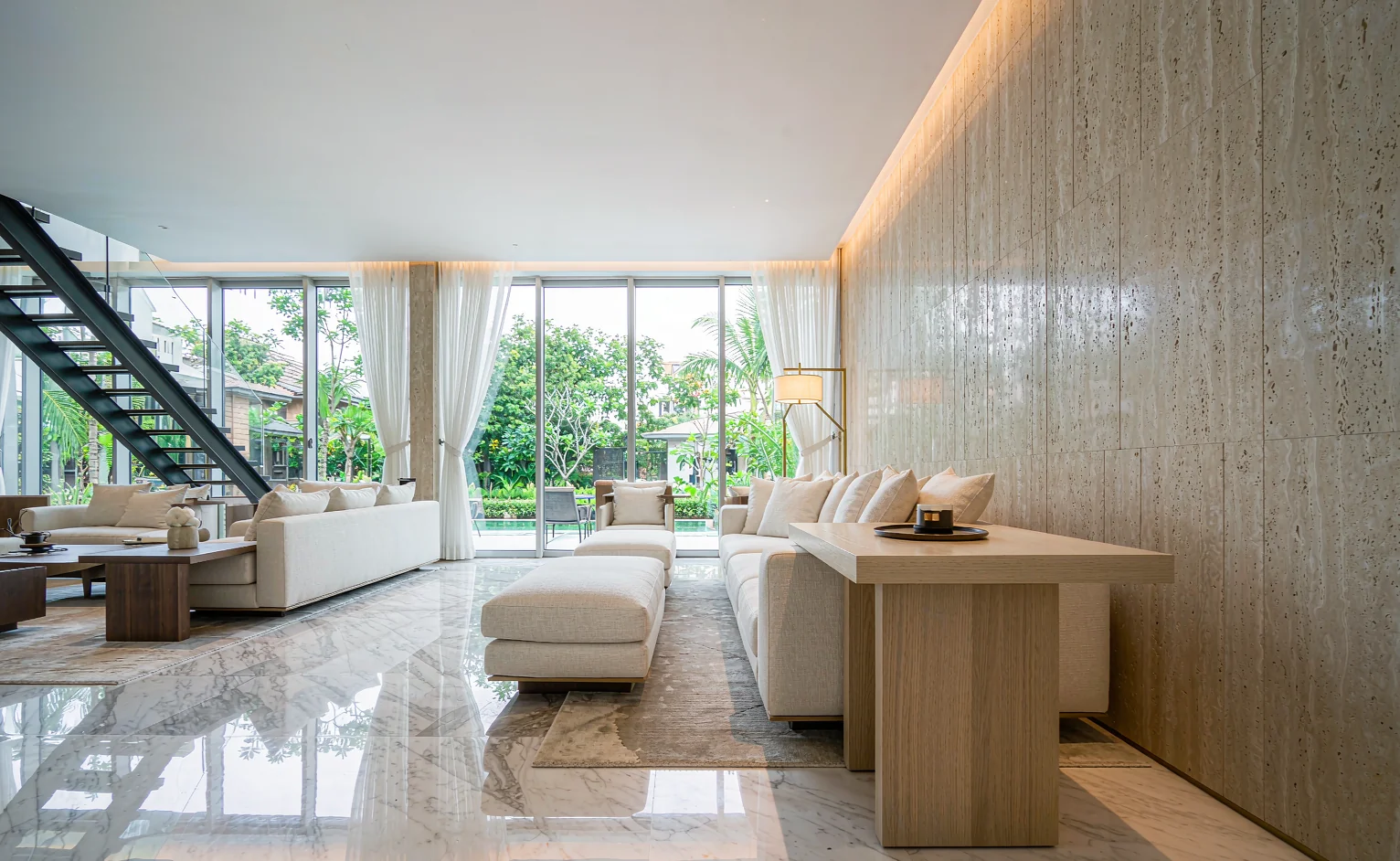
MATERIAL GUIDE
Natural Stone for Hot Climates: Marble & Granite Guide.
Published: October 2, 2026
Absorption, finish and sealing — the three decisions that decide whether marble, granite or travertine survives heat, humidity and dust.
Published: October 2, 2026
Absorption, finish and sealing — the three decisions that decide whether marble, granite or travertine survives heat, humidity and dust.
Across the Gulf, East Africa and the equatorial belt, natural stone is the material clients ask for first — and the one most often ruined by a wrong specification. The stone itself is rarely the problem. The selection, the finish and the sealing are. A marble that performs beautifully in a shaded hotel lobby will fail on an open terrace, and a granite chosen from a colour sample alone can arrive with an absorption rate triple the sample you approved. In our From Concept to Completion process, stone is specified as a system — type, finish, sealer and joint detail decided together, before the order is placed. This guide is written for owners and project managers who need to read a stone schedule without a geologist beside them.
The single number that predicts how stone survives a hot, humid, dusty climate is water absorption, measured by weight under EN 13755. Granite sits at 0.05–0.4%, marble at 0.1–0.5%, and travertine and most limestones at 0.5–2% or more. In a coastal city like Juba’s river corridor or a Gulf site within a few kilometres of the sea, absorbed moisture carries salt and dust into the pore structure; it expands in the daily heat cycle and spalls the surface within a few seasons. Hardness matters too: granite rates 6–7 on the Mohs scale and marble only 3–4, which is why a polished marble lobby floor needs a strict grit-dust matting plan while a granite entrance survives the same traffic untouched. For external floors and wet areas we cap absorption at 0.5% regardless of how good the sample looks — on our projects that single rule has eliminated most of the staining and efflorescence callbacks we used to see.
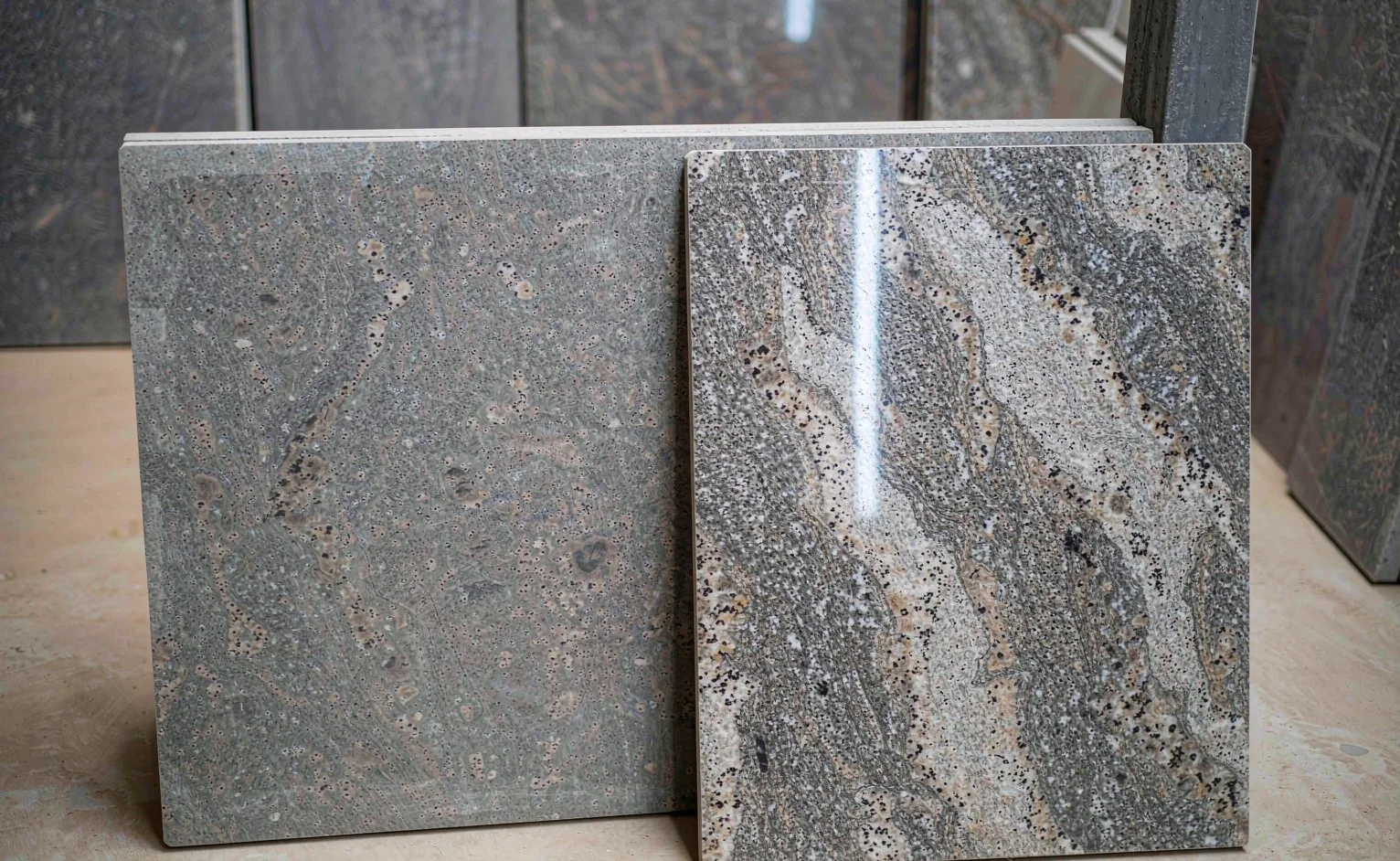
Two slabs of the same granite can behave like different materials depending on the finish. A polished surface is a mirror: ideal in a shaded interior, but wet it is slippery and outdoors it dulls under UV and abrasive dust within a couple of years. A honed finish is matte and slightly more open-pored, which is why we pair it with sealer indoors. For anything that gets sun and water at the same time — pool decks, entries, terraces — we specify a flamed or bush-hammered texture, which raises wet slip resistance to a pendulum test value (PTV) of 36+ and keeps it there, because the grip lives in the texture rather than in a coating. As a rule of thumb: polished inside, honed in covered transition areas, flamed or brushed anywhere barefoot and wet. On resort and villa projects from the Gulf to East Africa, that three-tier finish plan is what keeps a stone deck safe and looking new after its second rainy season.
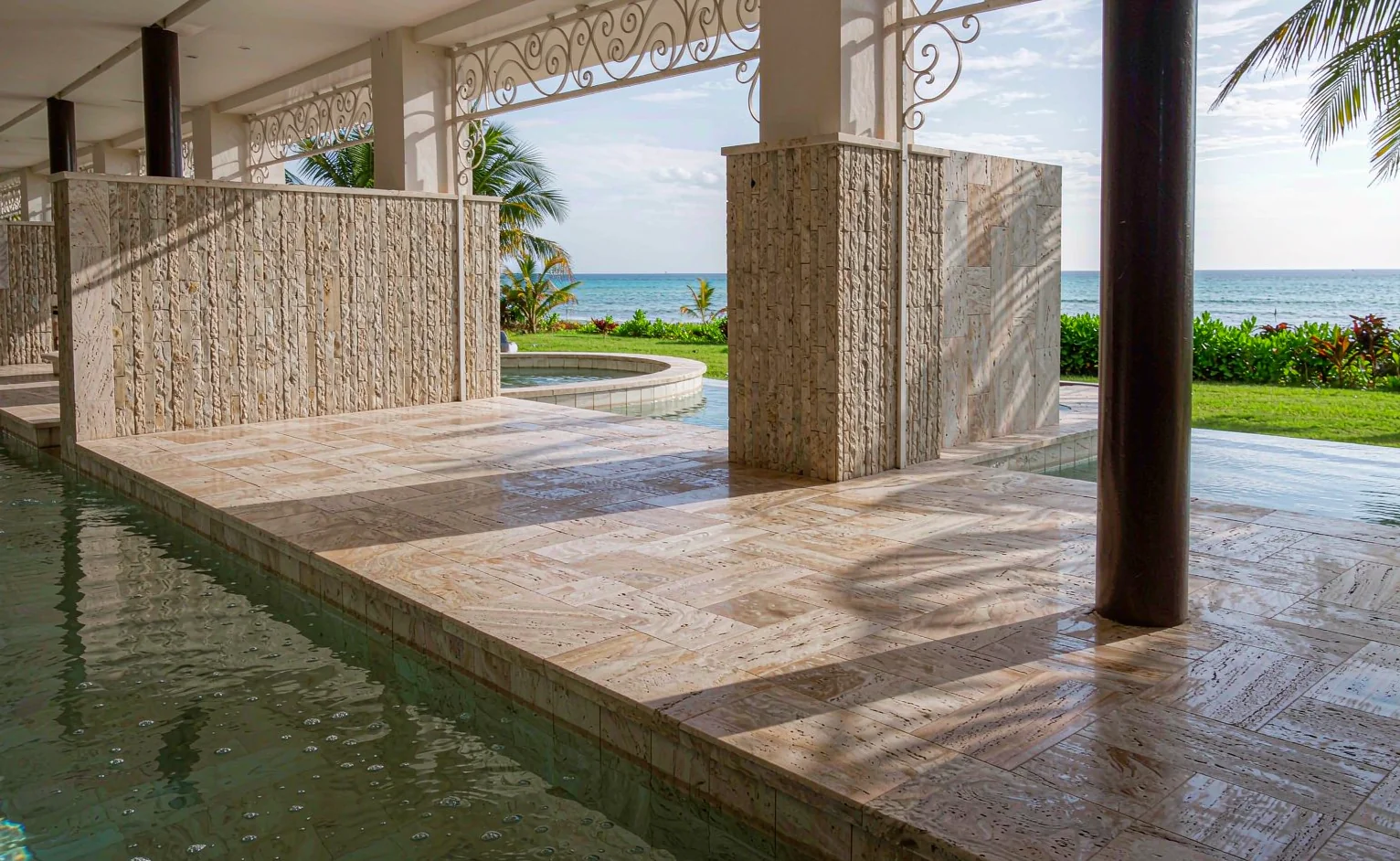
Unsealed travertine around a working pool can pick up permanent stains within weeks of handover. The fix is a penetrating (impregnating) sealer on every face, top and bottom, before and after fixing — on the marble and travertine samples we test, a quality impregnator cuts absorption by around 90%. What the datasheet will not tell you is the re-application interval: in wet, high-traffic areas plan on every 3–5 years, not the 10 a dry interior might allow, and put it in the maintenance schedule so it actually happens. Joints are the other half of the system. We specify epoxy grout instead of cement grout in all wet areas, movement joints at 4–6 m centres on large floors, and a breathable silicone seal at every change of material, so the daily thermal cycle of a 50 °C deck is taken by the joint rather than by the stone. Near the coast, stainless fixings and a salt-tolerant adhesive are part of the same line in the BOQ, not an upgrade to negotiate later.
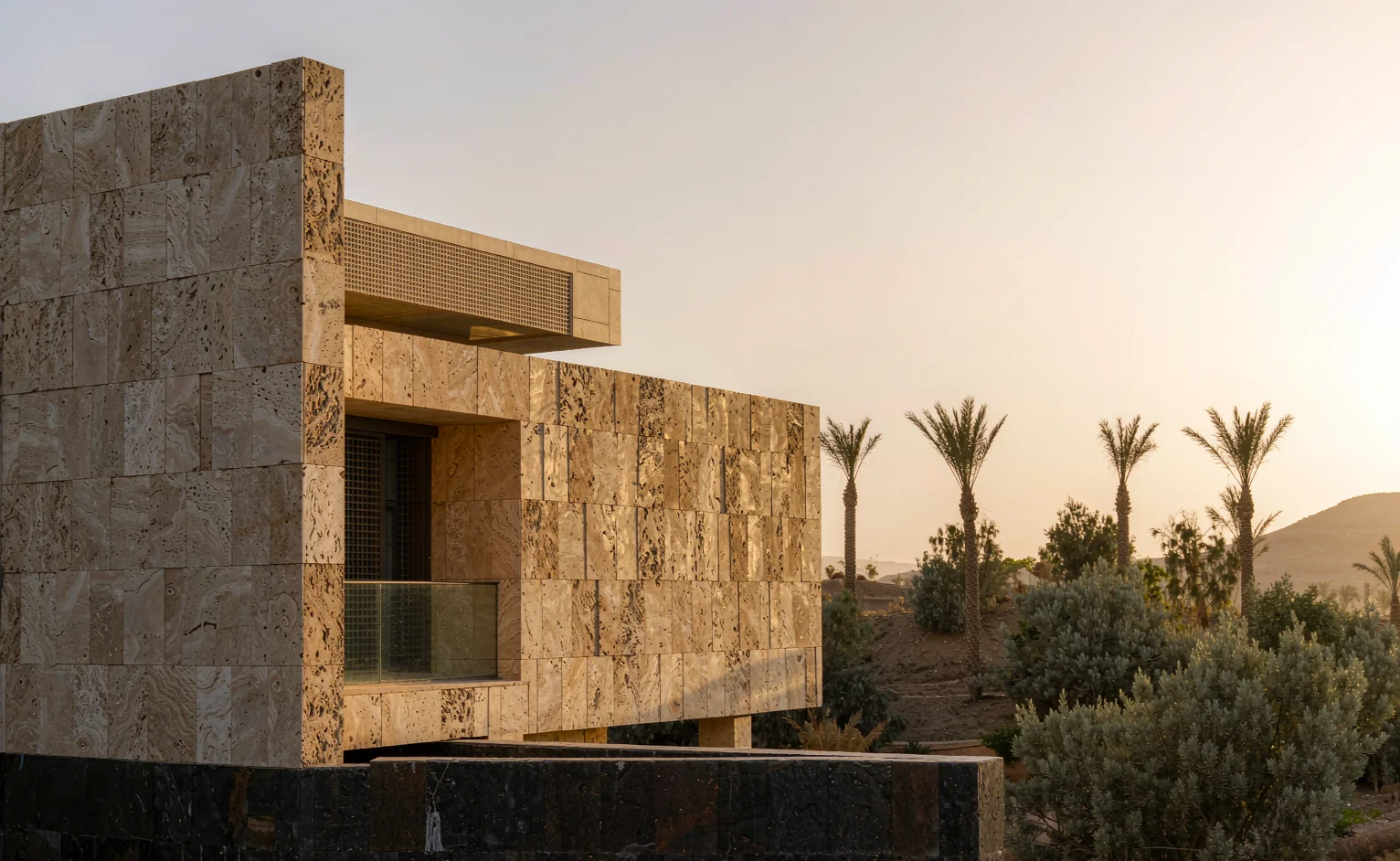
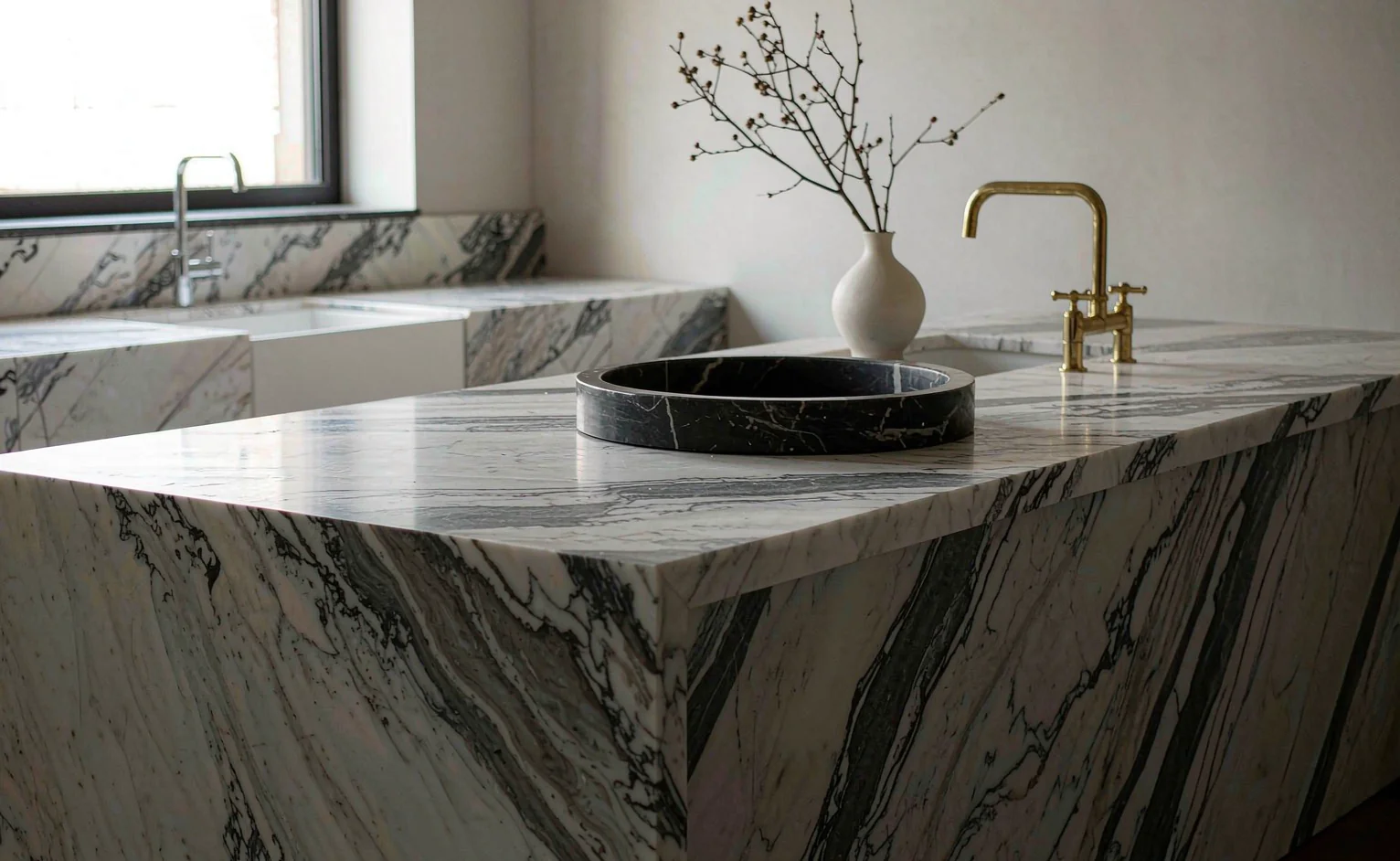
Stone varies block to block, and a name like “Emperador” or “Kashmir White” is a range, not a guarantee. The only specification that holds is the one tied to a physical reference: approve photographs of the actual block or slab, reserve that block for the full project quantity, and have every slab numbered by crate so the veining lines up across floors, walls and worktops. Thickness is part of the same discipline — 18–20 mm for interior floors, 30 mm for worktops, and 25–30 mm with mechanical fixing for external cladding, per EN 1469. We order 5–8% over the net area for cutting waste and keep a crate map on file, so a cracked tile in year three can still be matched to the original batch. It is the same block-approval logic we apply across every surface material — see how we handle it for Specifying Porcelain & Ceramic Tiles for Hot, Dusty Climates, and how the same field data drives Gulf vs East Africa: Two Material Baselines Compared.
| Stone | Water absorption (EN 13755) | Mohs hardness | Best use in hot climates | Minimum spec we apply |
|---|---|---|---|---|
| Granite | 0.05–0.4% | 6–7 | Pool decks, external floors, worktops | Flamed or brushed outdoors; 30 mm worktops |
| Marble | 0.1–0.5% | 3–4 | Lobby floors, vanity tops, feature walls | Honed indoors, sealed; 20 mm floors |
| Travertine | 0.5–2.0% | 3–4 | Pool surrounds, shaded terraces | Brushed and filled; sealed every 3 years |
| Limestone | 0.5–3.0% | 3–4 | External cladding, shaded interiors | 25–30 mm panels, mechanical fixing (EN 1469) |
Send us your drawings or stone schedule and we will return an itemized natural stone BOQ — types, finishes, thicknesses, sealer and fixing system — typically within one working day.
Request a Natural Stone BOQ →Which stone works best around a pool deck?
Honed or flamed granite and brushed travertine. Granite absorbs under 0.4% water by weight and shrugs off pool chemicals, while travertine stays cooler underfoot — both need a penetrating sealer to stay that way.
Does natural stone need sealing in humid climates?
Yes, every installation. A penetrating sealer cut absorption by around 90% on the marble and travertine samples we tested, and wet-area floors should be re-sealed every 3–5 years, not the 10 a dry interior allows.
Marble or granite for a project kitchen worktop?
Granite for most project kitchens — it resists etching, heat and the acids in daily cooking. Marble is the better choice on a low-use bar or vanity top, where the veining is worth the extra care. For the wider cabinet and worktop picture, see Kitchen & Cabinetry Materials Compared.
How do I avoid batch mismatch on a large stone order?
Approve the actual block or slab, not the brochure name. Reserve the block for the whole project, and have every slab numbered by crate so the veining lines up across floors, walls and worktops.
Related: Choosing Flooring for Tropical Climates, Specifying Aluminum Windows & Doors for Hot Climates, and Wall Panels for Hot Climates: WPC, SPC & ACP Compared.