Kenya Building Materials: What 150 Home Enquiries Ask For
Published: October 4, 2026
Kenya is our second-largest market — 150 customer records behind Ethiopia's 223. Here is what those enquiries actually order, how specs split between the Nairobi highlands and the Mombasa coast, and why 74% of the file stalls before the second quote.
Most "Kenya building materials" content online is written for contractors bidding government tenders. Our file tells a different story: of the 150 Kenya-linked customer records in our CRM, two-thirds are private homeowners fitting out a house they are building or renovating, one enquiry at a time. That file — name, demand, project type, follow-up status — is first-party data no market report can replicate, and it shows exactly which packages move and which ones stall. This article reads that file, and sets it against the climate split that decides every Kenyan specification: the 1,795 m highland plateau where Nairobi sits, and the salt-air coastline that runs from Mombasa to Lamu.
1. The Kenya file in numbers
Our CRM holds 150 Kenya-linked records: 141 tagged Kenya, plus individual entries pinned to Karen, Runda, Ruai and Makueni — an even split between leafy Nairobi suburbs and the drier south-east. Kenya is our second-largest market, behind Ethiopia (223 records) and well ahead of South Sudan (50) and Rwanda (15). The project mix is overwhelmingly residential: 66 records are tagged whole-home residential fit-outs, five are villas, two are apartments, and single records cover a hospital, a hotel, a wholesale account, a CNC factory and a showroom. Where buyers write their demand in full, three items dominate: tiles, kitchens and whole-home packages — nine records each — with stairs and solar named in three records each. The demand leaders map directly onto the deepest shelves of our 102,491-file supplier catalogue, in a pattern consistent across the five markets we serve.
What 150 Kenyan enquiries ask for — and the catalogue depth behind each quote
What buyers name
Records naming it
Catalogue depth behind the quote
Whole-home package (全屋)
9
102,491 files across 74 categories quoted as one schedule
Tiles
9
1,422 tile files across 11 sub-collections
Kitchen & appliances
9
408 kitchen & wardrobe files across 15 sub-collections
Stairs
3
4,134 staircase files across 3 sub-folders
Solar & storage
3
40 solar & storage files across 5 sub-collections
2. One country, two spec regimes: highlands vs coast
Kenya is the clearest example in our file of one country demanding two different specification regimes. Nairobi sits at roughly 1,795 m: equatorial sun with strong UV, a wide day-night temperature swing, and two rainy seasons — the long rains from March to May and the short rains around October to December. There we prioritize UV-stable powder coatings on aluminium, engineered boards conditioned to 8–10% moisture content so joinery does not shrink at altitude, and porcelain tiles at under 0.5% water absorption that shrug off the wet-season mud tracked through a Karen or Runda home. The coast inverts the problem: Mombasa runs near 32 °C with humidity above 80% for much of the year, and salt air attacks metalwork. Within 5 km of the shoreline, door and window hardware, balustrade posts and fixing screws move to 316 stainless — salt air pits 304 fittings within one to two years. The window and door systems we quote for coastal Kenya are set out in Specifying Aluminum Windows & Doors for Hot Climates, and the door material trade-offs in Doors for Hot & Humid Climates: WPC, Aluminium or Steel?
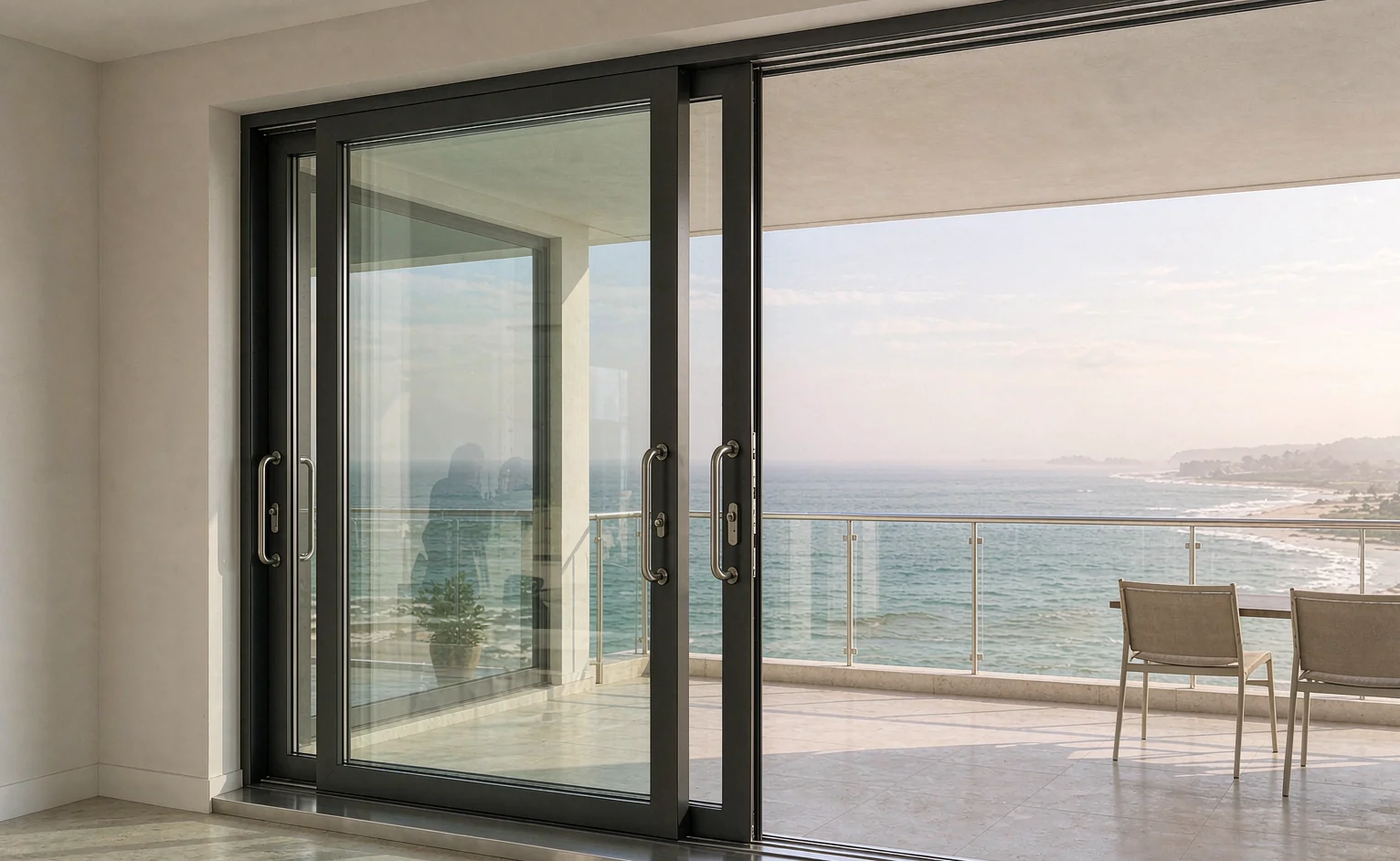
Coastal Kenya spec: powder-coated aluminium sliders with 316 stainless hardware — salt air pits lesser fittings within one to two years.
3. Tiles, kitchens and the whole-home package
The three demand leaders share one trait: they are the packages a Kenyan homeowner cannot easily source locally at export quality. On tiles, our 1,422-file tile library lets us quote by format and duty — porcelain floor tiles at 8–10 mm and under 0.5% absorption for living areas, lighter-body wall tiles for bathrooms, anti-slip ratings for wet zones — instead of asking the buyer to accept whatever a container mixed. On kitchens, the 408-file kitchen and wardrobe library backs quotes for moisture-resistant carcasses, sealed edges and soft-close hardware rated for humid kitchens, which is where cheap board stock fails first. And the whole-home enquiries — nine records asking us to price everything from flooring to light switches — are the ones we quote as one schedule with one lead time and one shipping plan: flooring, cabinetry, sanitary ware, lighting and doors consolidated into a single container to Mombasa or a direct Nairobi delivery. The flooring choice under most of these packages is set out in Choosing Flooring for Tropical Climates, the cabinetry comparison in Kitchen & Cabinetry Materials Compared, and the tile selection logic in Specifying Porcelain & Ceramic Tiles for Hot, Dusty Climates.
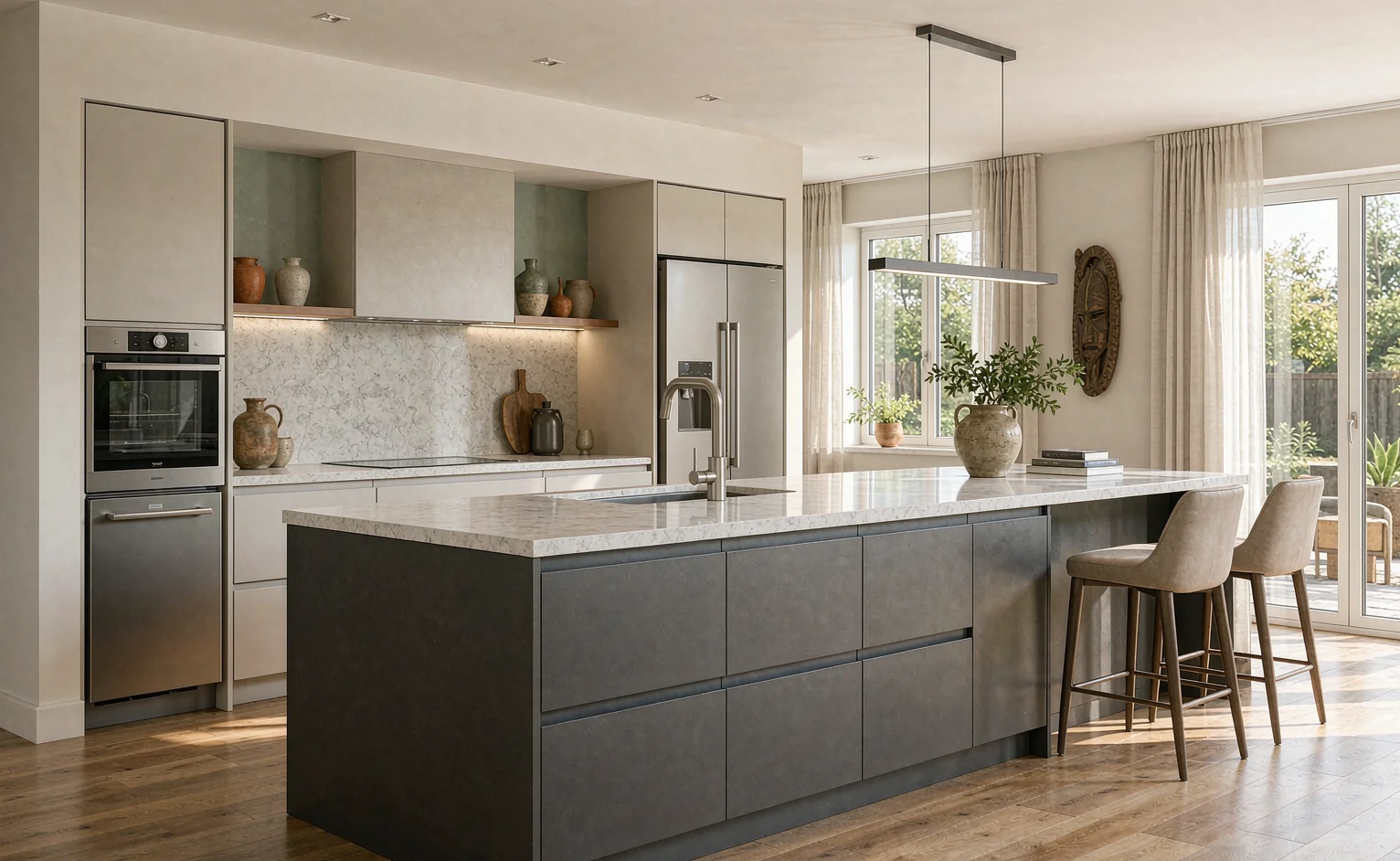
Kitchens are one of three packages Kenyan buyers name most: moisture-resistant carcasses and sealed edges decide how the joinery survives a humid kitchen.
4. The 74% follow-up gap — and what closes it
The uncomfortable number in our own file: 111 of 150 Kenya records — 74% — carry no follow-up status beyond the first contact, only four show a completed quotation, and just one has reached payment. The demand notes explain why. Enquiries arrive as fragments — "4bedroom, tiles, gypsum, cabinets, taps, electrical materials, solar panels, doors" is a real record — and a buyer assembling that scope across five or six vendors always waits on the slowest one. When every vendor quotes separately, the first quote sits in a WhatsApp chat while the buyer chases the rest, and the project cools. What revives these files is consolidation: pricing tiles, kitchens, wardrobes, sanitary ware, lighting and doors as one schedule, with one lead time, one quality standard and one point of accountability — the same single-schedule logic that turns a stalled villa file into a shipped container. The follow-up gap is not a Kenya weakness; it is the natural result of how residential building materials are bought in East Africa, and the vendors who close it win the whole house, not one room.
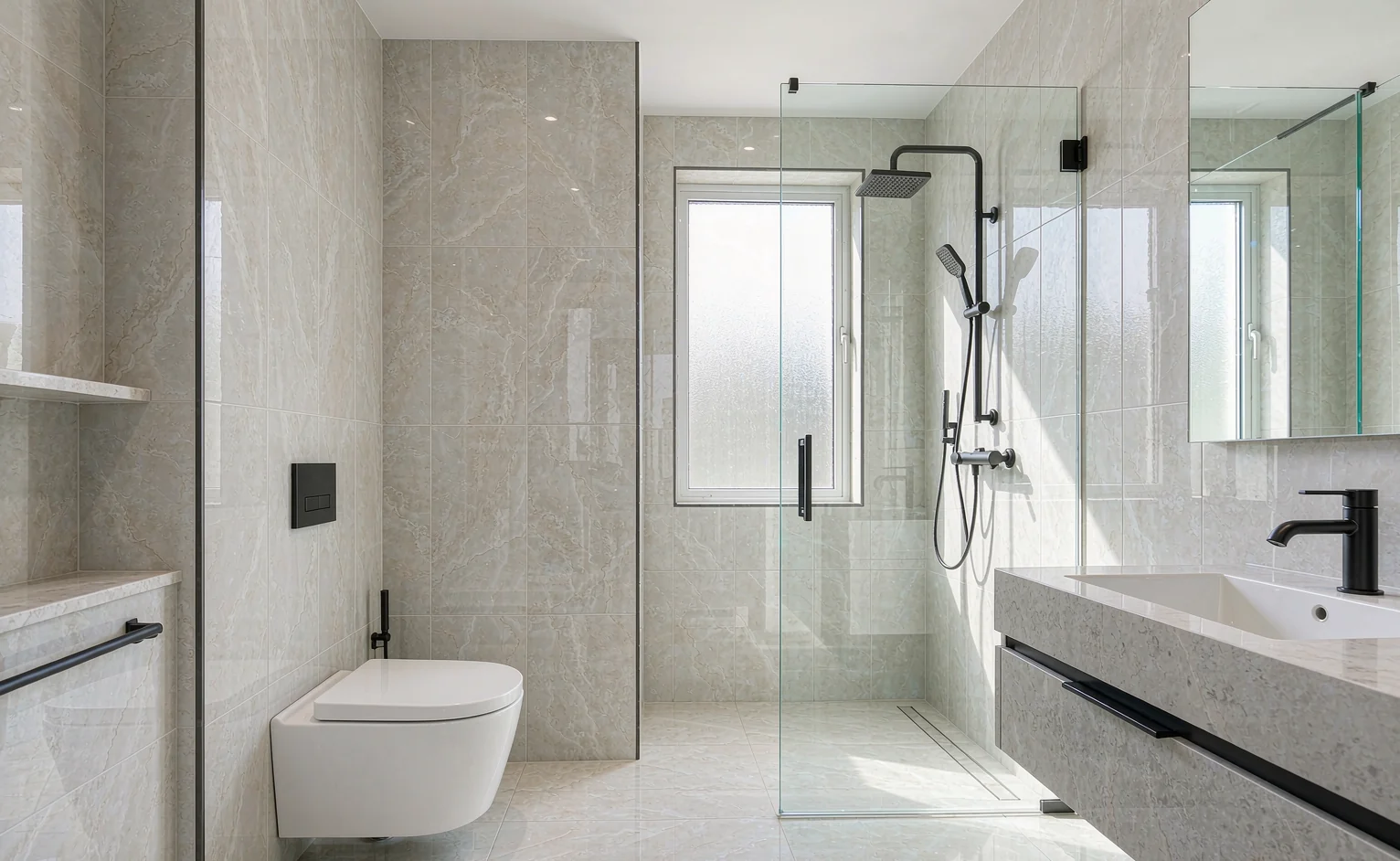
Bathroom packages inside a whole-home schedule: large-format porcelain and wall-hung sanitary ware quoted with the same lead time as the kitchen.
Four numbers that define the Kenyan market
150 Kenya-linked records — our second market, behind Ethiopia's 223.
66 records tagged whole-home residential; villas and apartments make up the rest of the private file.
Tiles, kitchens and whole-home packages lead demand — nine records each.
74% of records stall with no follow-up status; single-schedule quotes are what restart them.
Planning a Kenyan fit-out?
Send us your room list, finishes and port — Mombasa or a direct Nairobi delivery — and we will return one consolidated schedule covering tiles, kitchen, wardrobes, sanitary ware, lighting and doors, quoted with a single lead time.
How many Kenyan customer records does INDECO's CRM hold?
Our CRM holds 150 Kenya-linked records — 141 tagged Kenya plus place-tagged entries in Karen, Runda, Ruai and Makueni. That makes Kenya our second-largest market behind Ethiopia's 223 records and ahead of South Sudan's 50. See Rwanda & Uganda: Materials for Landlocked Projects.
What materials do Kenyan buyers ask for most?
In our file the demand leaders are whole-home packages, tiles and kitchens — nine records each explicitly name tiles or kitchens, and nine ask for a full whole-home fit-out. Stairs and solar each appear in three records. Behind those quotes sit 1,422 tile files, 408 kitchen and wardrobe files and 102,491 catalogue files across 74 categories. See Specifying Porcelain & Ceramic Tiles for Hot, Dusty Climates.
How do material specs differ between Nairobi and the Kenyan coast?
Nairobi sits at about 1,795 m with strong UV and a wide day-night temperature swing, so we prioritize UV-stable powder coats, engineered boards at 8–10% moisture content and porcelain under 0.5% absorption. The Mombasa coast adds salt air: within 5 km of the shoreline, door and window hardware, balustrade posts and fixings move to 316 stainless, because salt air pits 304 fittings within one to two years. See Specifying Aluminum Windows & Doors for Hot Climates.
Why do so many Kenyan fit-out projects stall after the first quote?
In our Kenya file, 111 of 150 records — 74% — carry no follow-up status beyond the first contact, and only one has reached payment. The usual cause is fragmentation: a home split across five or six vendors waits on the slowest one. Quoting tiles, kitchens, wardrobes, sanitary ware and lighting as one schedule with one lead time keeps every trade moving on the same programme. See Kitchen & Cabinetry Materials Compared.