Lighting & Switches for Hot Climates: The LED Spec Guide
Published: October 5, 2026
A 40 °C ceiling void, 90% humidity, dust that never stops, and a mains supply that swings from 180 V to 260 V — the fitting that survives all four is chosen on different numbers. Here is the lighting and switch specification we quote from Addis Ababa to Riyadh, and what 14 lighting enquiries in our 596-record file actually asked for.
Lighting is the one material package where failure is immediately visible: a lamp that dies in year two is a defect in a way a slightly dull tile never is. In hot climates the failure is rarely the LED chip itself — it is the driver running hot, the gasket that stopped keeping dust out, or the surge that arrived down the mains. Our supplier catalogue carries 716 lighting and switch files across 7 sub-folders, 510 of them street and outdoor LED; after quoting these into African and Gulf projects we now specify on five numbers rather than wattage and price.
1. Why heat, dust and voltage decide how long a lamp lasts
Three forces shorten lighting life here, and only one of them is the chip. Heat. An LED chip is robust; the electrolytic capacitor in its driver is not. Capacitor life roughly halves for every 10 °C rise above its rated ambient, so a luminaire rated at 25 °C installed in a concrete ceiling void that reaches 40–45 °C runs 15–20 °C outside its test condition — the difference between a five-year fitting and an eighteen-month one. Dust. Fine dust settles on diffusers, inside open track channels and into unsealed switch plates — a 1 mm film can cost 10–15% of delivered light within a season, and dust in the driver cavity insulates where the heat needs to leave. Voltage. Nominal supply is 220–240 V / 50 Hz, but on some networks we see 180 V at the end of a feeder and 260 V at night, plus switching surges — which is why we quote wide-input drivers (100–300 V) and a surge device at the board rather than relying on the fitting. The ceiling assembly matters as much as the luminaire: recessed cut-outs and service voids sit in the hottest air in the building, as set out in Ceiling Materials for Hot & Humid Climates: Spec Guide.
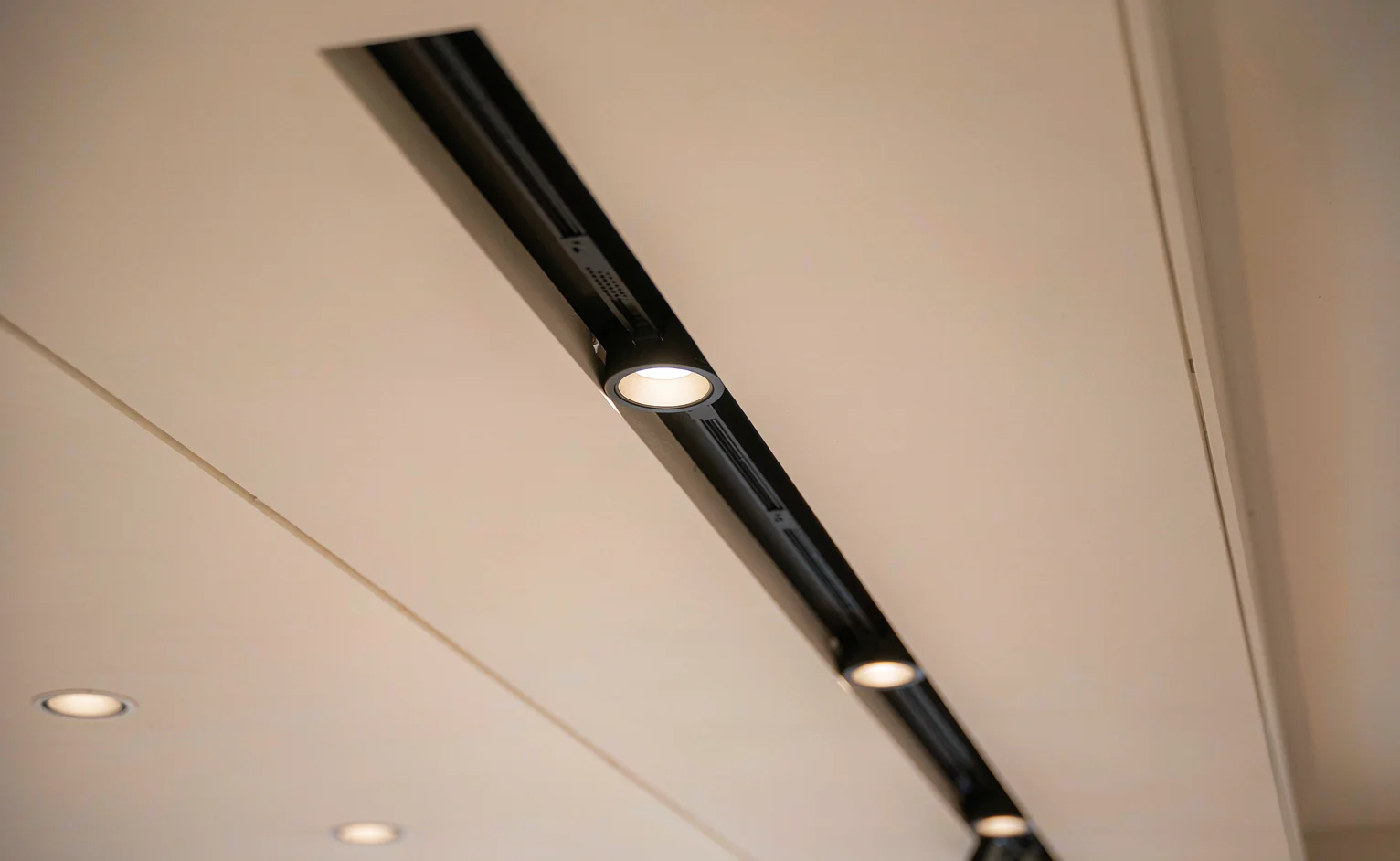
Recessed track and downlights deliver the clean ceiling line clients ask for, but every body sits in the hottest air in the building — the driver rating, not the trim, decides the warranty.
2. What 14 lighting enquiries in our file actually asked for
Our customer file holds 596 records; 14 of them name lighting or electrical fittings in the brief. Kenya leads with 6, Ethiopia follows with 3, and Ghana, South Sudan, Saudi Arabia and the United States account for the rest. Two patterns stand out. First, lighting almost never arrives alone: 11 of the 14 asked for it alongside tiles, sanitary ware, cabinets or solar — a Kenyan owner wrote that the exterior was finished and they needed kitchen, lighting next, and another listed tiles, solar light fittings, sanitary and kitchen ware in one message. Second, buyers ask for the catalogue before they ask for a price: one Kenyan client is logged as “lighting catalogue sent”, and an Ethiopian engineer requested LED fittings for an apartment block, both served from the same 716-file library.
Lighting and electrical enquiries in the INDECO file (14 of 596 customer records)
Market
Records
What they asked for
Buyer type
What it implies for the quote
Kenya
6
Lighting at finishing phase, lamps with tiles and gypsum, solar light fittings, lighting catalogue requests
Homeowners 4, specifier 2
Room-by-room lighting schedule bundled with tiles and sanitary in one load
Ethiopia
3
LED fittings for an apartment block, lamps with locks and cabinet hardware, trade LED enquiry
Engineer, trader, owner
Project quantities with a driver rating stated on the schedule; 45 °C ambient
Saudi Arabia
1
Compound street lighting for a contracting package
Contractor
IP66 pole fittings, surge protection, worst-month solar sizing if off-grid
Ghana
1
Lighting within a whole-house package (shipped)
Owner
Consolidated container with the rest of the fit-out, one bill of lading
South Sudan
1
Bar and decorative lighting for a hospitality fit-out
Owner
Higher CRI and dimming for hospitality; sealed fittings for a dusty site
United States
2
LED ceiling recessed lights with flooring and tiles
Owner, trader
Confirms the same 40 °C-ambient driver logic travels with the product
3. The five numbers we specify instead of wattage
Wattage alone tells a client almost nothing. These are the five figures we put on a lighting schedule. Ambient and driver rating: a driver rated to 45–50 °C ambient with wide input of 100–300 V, and a heat sink that is not buried under insulation. IP rating: IP20 dry interiors, IP44 bathrooms and covered kitchens, IP65 exposed, IP66 on the shoreline. Efficacy: 100–130 lm/W — the low end is what a budget fitting delivers after a year of dust. Colour quality: CRI ≥ 80 for homes and ≥ 90 for hospitality and retail, with consistency inside SDCM ≤ 5 so fittings bought a year apart still match. Maintenance: L70 at 50,000 hours backed by an LM-80 report and a 3–5 year warranty that names the ambient temperature — a five-year warranty on a 25 °C rating is not a five-year warranty in Juba or Riyadh. Surface finishes interact with all five: matt, non-absorbent walls reflect light instead of soaking it up, which is why the panel schedule in Wall Panels for Hot Climates: WPC, SPC & ACP Compared belongs in the same conversation as the lighting layout.
Lighting specification baselines by application, hot and humid climates
Application
IP
CCT
CRI
Efficacy
Additional requirement
Living, bedrooms, offices
IP20
3000 K
≥80
≥100 lm/W
Dimmable driver, ambient-rated, no insulation contact
Kitchen and bathroom zones
IP44
4000 K
≥80
≥100 lm/W
Sealed gasket against insects and damp; extractor on the same circuit
Covered terrace, soffit, carport
IP54
3000–4000 K
≥80
≥110 lm/W
Corrosion-resistant body; drain path so water cannot pond in the housing
Facade, garden, gatehouse
IP65
3000 K
≥80
≥110 lm/W
316 stainless trim and fixings within 5 km of the coast
Compound and street lighting
IP66
4000 K
≥70
≥130 lm/W
4–6 kV surge protection; LiFePO4 with 2–3 day autonomy if solar
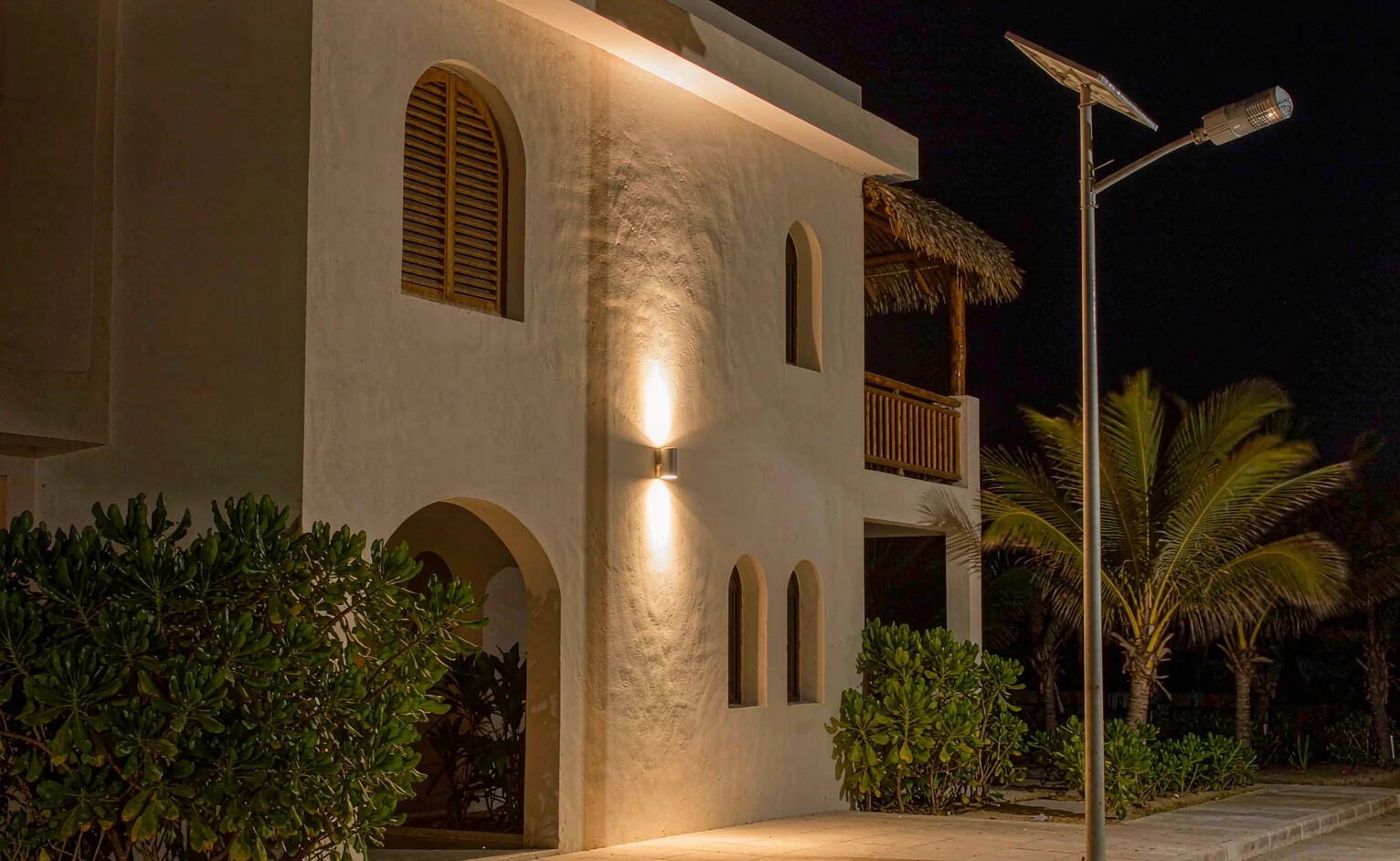
Exterior lighting is a corrosion specification before it is a design one: IP65 bodies with 316 stainless trim survive the salt band, and a solar head only works when the panel is sized for the worst month.
4. Switches, sockets and the half of the spec nobody quotes
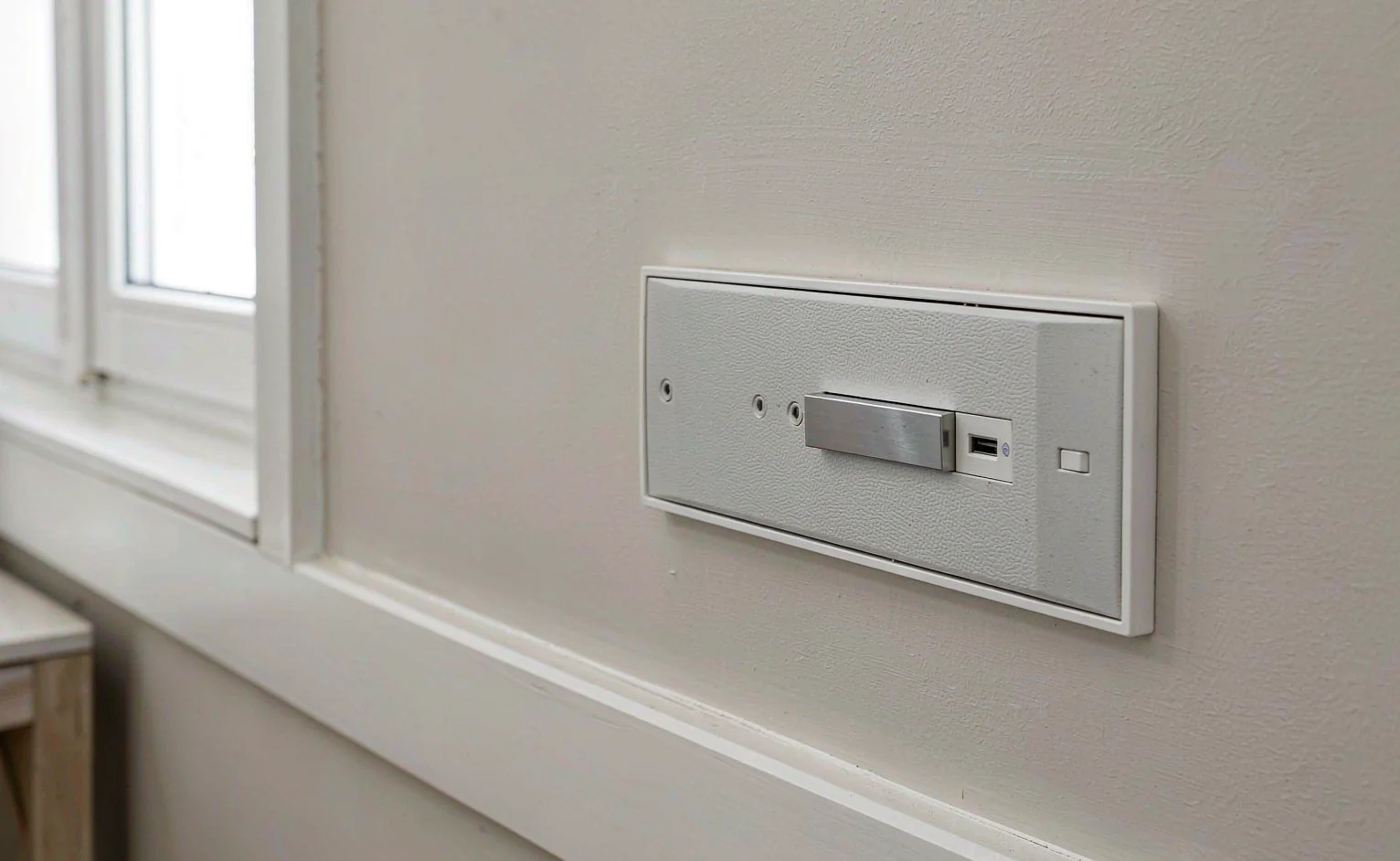
The plate on the wall is where a project quietly fails. We quote 86 × 86 mm plates with silver-alloy contacts rated 10 A / 250 V and flame-retardant polycarbonate fronts, not thin ABS plates that discolour and go brittle in two summers. Three details do the work. Gasketing keeps dust and insects out of the mechanism — an unsealed plate admits both, and contact resistance rises as the contacts oxidise. Voltage tolerance matters because the network that gives 260 V at night gives 180 V at the far end of the line, so switchgear and dimmers should be rated for the full range and paired with Type 2 surge protection at the board. Finish consistency matters on a hotel with 300 plates: three production batches show three shades of white within a year, so we ship one batch with a stated shade and keep spares from it. Fittings inside bathroom zones follow the waterproofing logic of Specifying Sanitary Ware & Bathroom Fittings for Hot, Humid Climates, and exterior sensors and gate lights are wired into openings that follow Specifying Aluminum Windows & Doors for Hot Climates. Freight follows the usual rule: diffusers in reinforced cartons, drivers in their own inner boxes, consolidated with the tiles and sanitary ware into one 40 HQ load.
The 86 × 86 mm plate with silver-alloy contacts and a gasketed back box — cheap to upgrade, and the item a client touches every day.
Lighting and switch spec checklist
Drivers rated for 45–50 °C ambient with 100–300 V wide input; heat sink clear of insulation and out of the ceiling-void hot spot.
IP20 dry interiors, IP44 bathrooms and kitchens, IP65 exposed, IP66 on the shoreline — with 316 stainless trim and fixings within 5 km of the sea.
100–130 lm/W efficacy, CRI ≥80, ≥90 for hospitality, SDCM ≤5, L70 at 50,000 hours with an LM-80 report and a 3–5 year warranty that names the ambient rating.
86 × 86 mm plates, silver-alloy contacts 10 A / 250 V, gasketed back boxes, Type 2 surge device at the distribution board.
Consolidate the lighting package into the same container as tiles and sanitary ware, with diffusers braced and drivers in inner boxes.
Planning lighting for an African or Gulf project?
Send the floor plan and tell us the port and the ceiling type. We will return a room-by-room lighting schedule with driver ratings, IP classes and colour consistency stated, priced with the tiles, ceilings and sanitary ware so the fit-out lands as one shipment.
Because the driver, not the chip, is the weak point. Electrolytic capacitors lose roughly half their rated life for every 10 C rise above their rating, and a luminaire rated at 25 C installed in a 40-45 C concrete ceiling void runs 15-20 C hotter than its test condition. We specify drivers rated for 45-50 C ambient with wide-input voltage of 100-300 V, and keep the heat sink out of insulation contact. See Ceiling Materials for Hot & Humid Climates: Spec Guide.
What IP rating do I need for outdoor lighting in coastal Africa?
IP65 minimum for anything exposed, and IP66 on the shoreline where wind-driven rain arrives at an angle. Within about 5 km of the sea we also move trims and brackets to 316 stainless instead of 304 or galvanised steel, because chloride eats thin galvanising inside one wet season. The same coastal logic applies to window and door hardware, set out in Specifying Aluminum Windows & Doors for Hot Climates.
Are solar street lights reliable through the rainy season?
Only if the battery is sized for the autonomy you actually need. We calculate on 2-3 days of autonomy with a LiFePO4 pack, size the panel for the worst month rather than the annual average, and fit a 4-6 kV surge protector on the pole. Budget fittings that advertise three rainy days of autonomy usually hold one, and a 30 W lamp claiming 6,000 lumens is measuring at the chip, not at the ground.
What switch and socket specification suits African and Gulf projects?
An 86 x 86 mm plate with silver-alloy contacts rated 10 A / 250 V, flame-retardant polycarbonate, and a gasketed back box that keeps dust and insects out. Because supply voltage on some networks swings between roughly 180 V and 260 V against a 220-240 V nominal, we pair the plate with wide-input drivers and a Type 2 surge device at the distribution board. What buyers actually ask for is summarised in 596 East African Enquiries: The Material Specifying Pattern.