Roofing Materials for Hot & Tropical Climates: Spec Guide
Published: October 6, 2026
The roof takes the hardest hit in an African or Gulf build: peak solar load, monsoon downpours, wind uplift and coastal salt on one plane. This guide compares the three roofing systems we supply across our 596-enquiry file and matches each to its climate zone.
Roofing is the one material decision that touches every project in our file, yet the one most often left to the roofer on site. Our catalogue of 102,491 files across 74 categories carries a dedicated roofing line — stone-coated metal tile and asphalt shingle catalogues with SGS and CE documentation among its 37 files. The enquiry book of 596 customer records, mapped in detail in 596 East African Enquiries: The Material Specifying Pattern, is dominated by low-rise, pitched-roof buildings: 106 villa enquiries, 86 home fit-outs, 46 apartment projects and 22 hospitality jobs across Ethiopia (247 records), Kenya (141), South Sudan (59), Rwanda (15) and the Gulf. Roofs fail by heat, water and wind long before walls do — so the specification order matters.
1. What a hot climate actually does to a roof
Four failure modes decide every roofing spec in our markets. Heat: an unventilated metal roof in Juba or Jeddah regularly pushes 70–80°C surface temperatures, and everything below inherits that heat. UV: at Addis Ababa's ~2,200 m altitude, thinner air means harder UV on coatings and membranes than at sea level. Water: tropical rain arrives as short, violent downpours, so gutter capacity and flashing laps matter more than annual averages. Wind and salt: cyclone-exposed coastlines from Mombasa to Lagos lift poorly fastened sheets, and airborne salt corrodes the wrong metals within two to three seasons. One Kenyan homeowner in our file asked for “solar sheet roofing” outright — roofs are increasingly expected to carry PV, which favours walkable metal profiles over brittle tile.
Three roofing systems compared for hot-climate specification
Property
Stone-coated metal tile
Asphalt shingle
Coated steel sheet
Base material
0.4–0.5 mm aluzinc steel (55% Al-Zn, AZ150-class coating)
Glass-fibre mat saturated with modified bitumen
0.3–0.5 mm galvanised or aluzinc steel, PVDF/polyester paint
Surface
Acrylic-glazed natural stone chips, many colourways
Mineral granules on bitumen, self-sealing laps
Paint film only — profile does the work
System weight
~6–7 kg/m² — light, walkable, solar-ready
~10–12 kg/m² incl. decking
~4–5 kg/m² — lightest option
Heat behaviour
Stone layer buffers surface heat; ventilated cavity below
Softens above ~70°C surface; granule loss accelerates
Fast heat transfer unless insulated; light colours reflect best
Wind uplift
Interlocked and screw-fixed; tested above 120 km/h
Self-seal laps fail under repeated lift on exposed ridges
Good if purlin spacing and fixing pattern are respected
Service life (hot zone)
30–50 years per catalogue warranty
Full life at altitude; roughly halved in lowland heat
10–20 years depending on coating class
Documentation on file
SGS certification + CE test report in our roofing catalogue
Supplier catalogue with spec sheets
Supplier catalogue with spec sheets
2. Stone-coated metal tile: the default for villa Africa
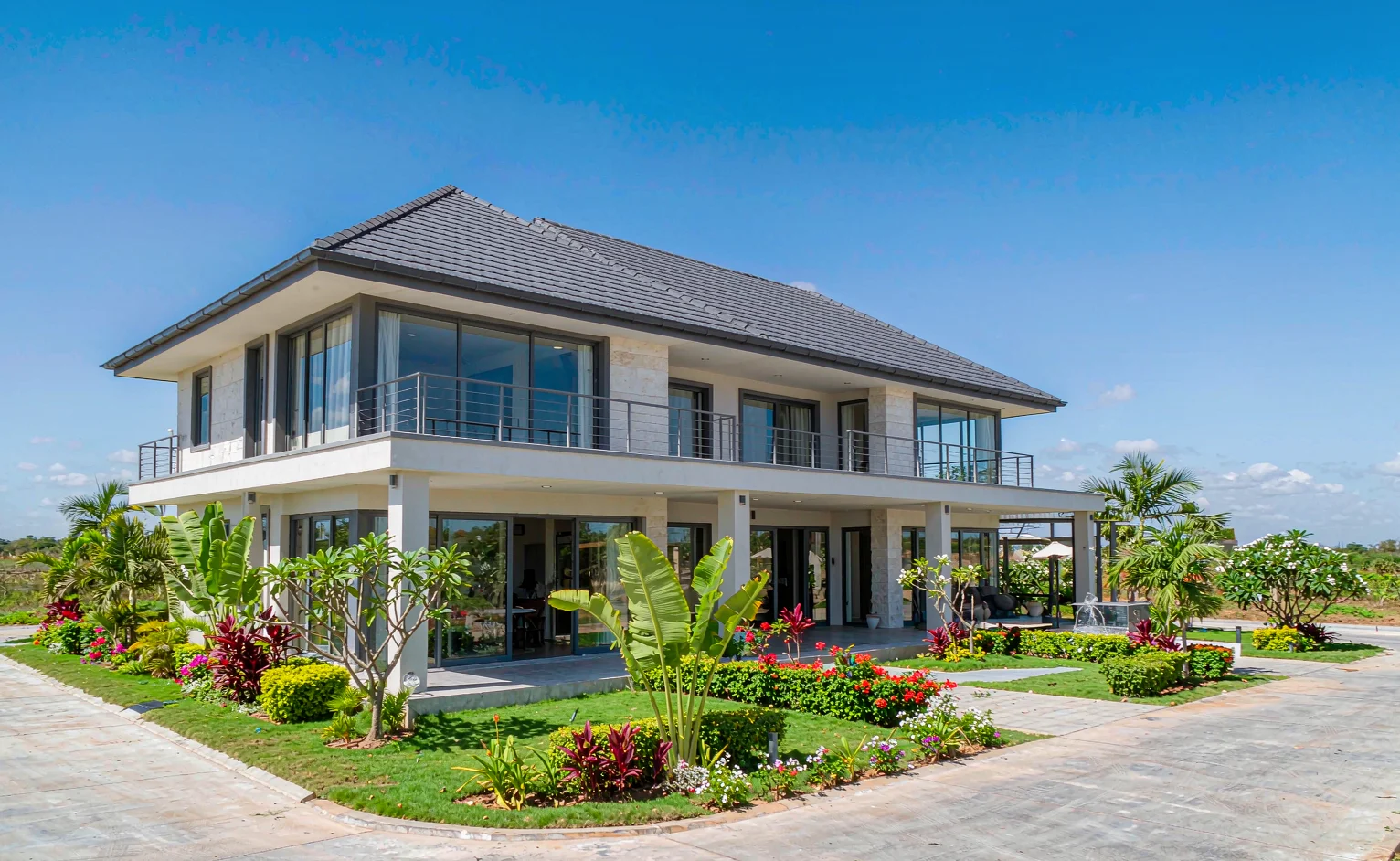
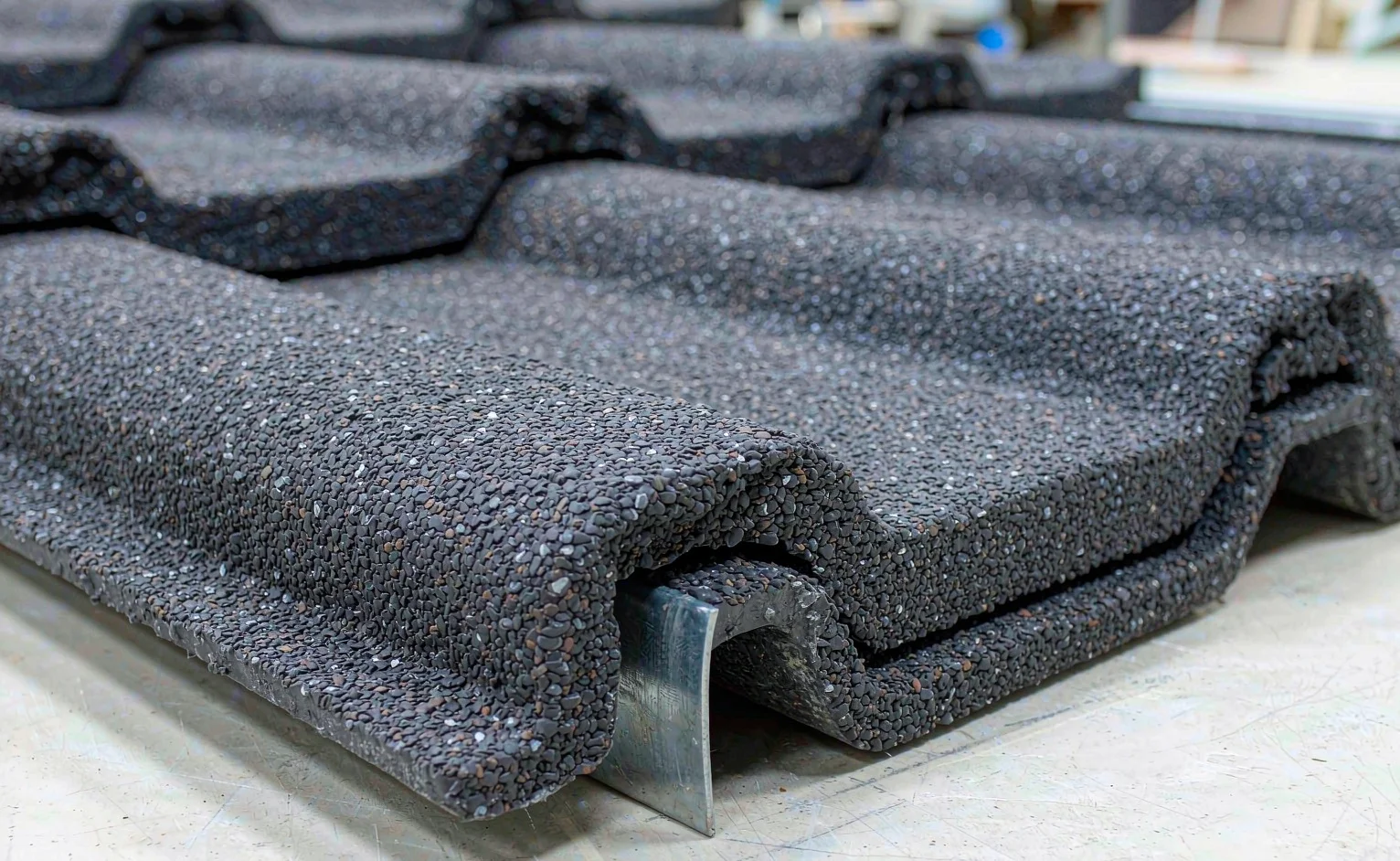
For the villa-led demand in our file — 106 villa enquiries from 600 sqm compounds in South Sudan to a 2,000 sqm estate in Ethiopia — stone-coated metal tile is what we quote first. It is a 0.4–0.5 mm aluzinc steel blank, pressed into a tile profile, bonded with stone chips and sealed in acrylic glaze: the steel gives corrosion resistance and interlocking strength, the stone layer gives the look of clay tile at one-fifth the weight. Three properties make it suit hot climates specifically. It stays walkable and drill-friendly for later solar mounting, and it interlocks and screws down on battens, resisting the uplift that peels loose-laid sheets. And because the profile is dry-fixed, a roof goes on in days without curing time — useful when a client such as our 20 × 20 m South Sudan hotel owner wants the building closed before the rains. The stone-coated line carries SGS certification and a CE test report, the two documents procurement teams ask for before a tile contract.
Stone-coated metal tile: an aluzinc steel blank pressed into a tile profile, stone-chip faced and acrylic-glazed — the look of clay tile at one-fifth of the weight.
3. Asphalt shingle: the highland answer, with a heat limit
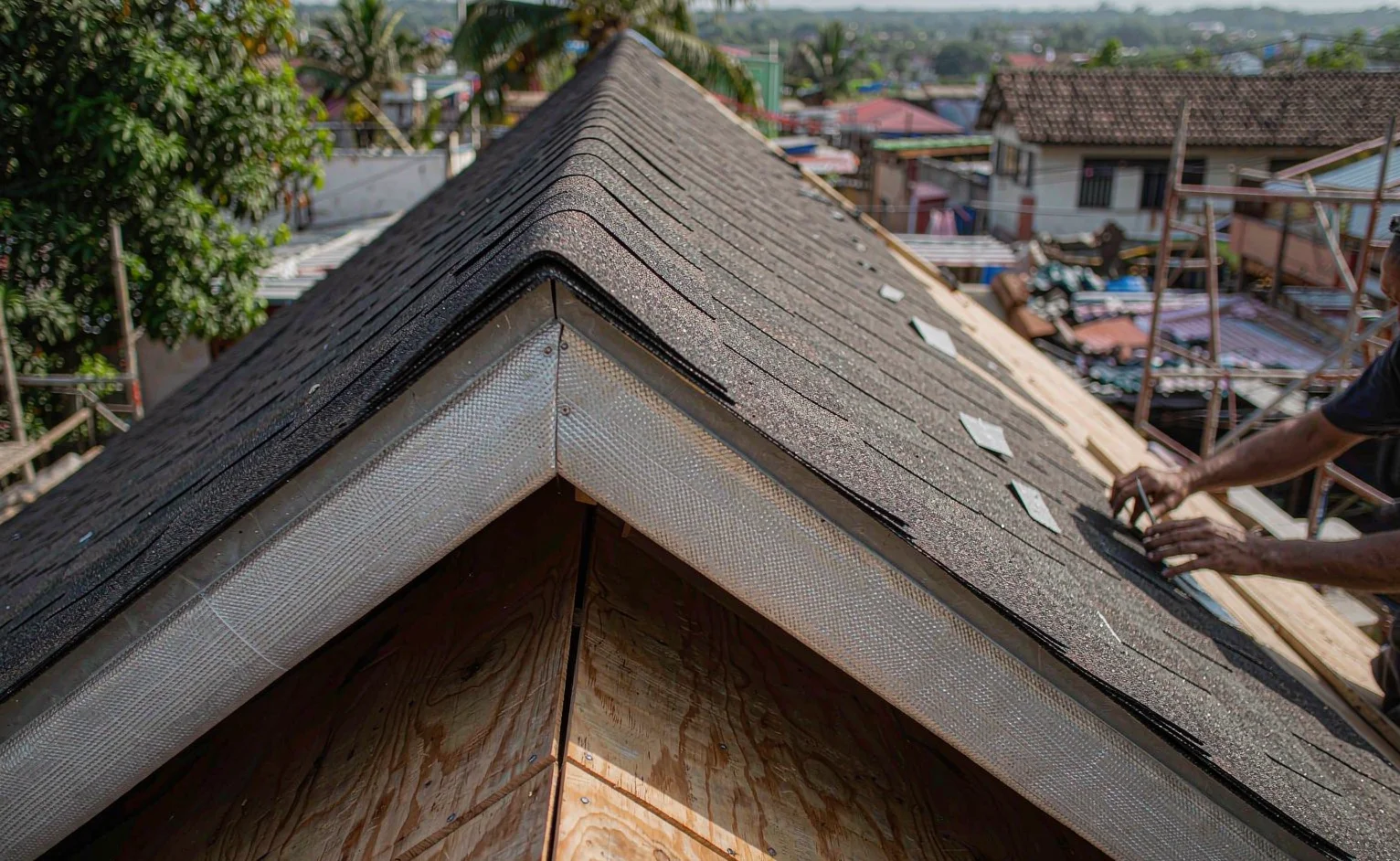
Asphalt shingle is the second line in our catalogue, and the file shows where it belongs. At altitude it is the best-value pitched roof available: on the Ethiopian highlands around Addis Ababa and in Rwanda, roof surface temperatures stay moderate, the self-sealing laps bond properly, and a quality shingle delivers its full 20–30 year life at lower installed cost than stone-coated metal. In the lowlands and on the coast it is the wrong product: when roof surfaces run above ~70°C day after day, the bitumen softens, granules shed into the gutters, and the effective life roughly halves. The dividing line we use is roughly 1,500 m elevation: above it, shingle is efficient; below it, metal wins on heat. Where a client insists on the shingle look in a hot lowland zone, we mitigate with lighter colours, ridge and soffit ventilation, and the coating discipline set out in Paints & Coatings for Hot Climates: Full Wall System — the same reflective-pigment logic applied to the roof plane.
Asphalt shingle laid over underlayment and decking: best value on highland sites such as Addis Ababa, but it softens and sheds granules where lowland roof surfaces pass 70°C.
4. The build-up wins, not just the sheet
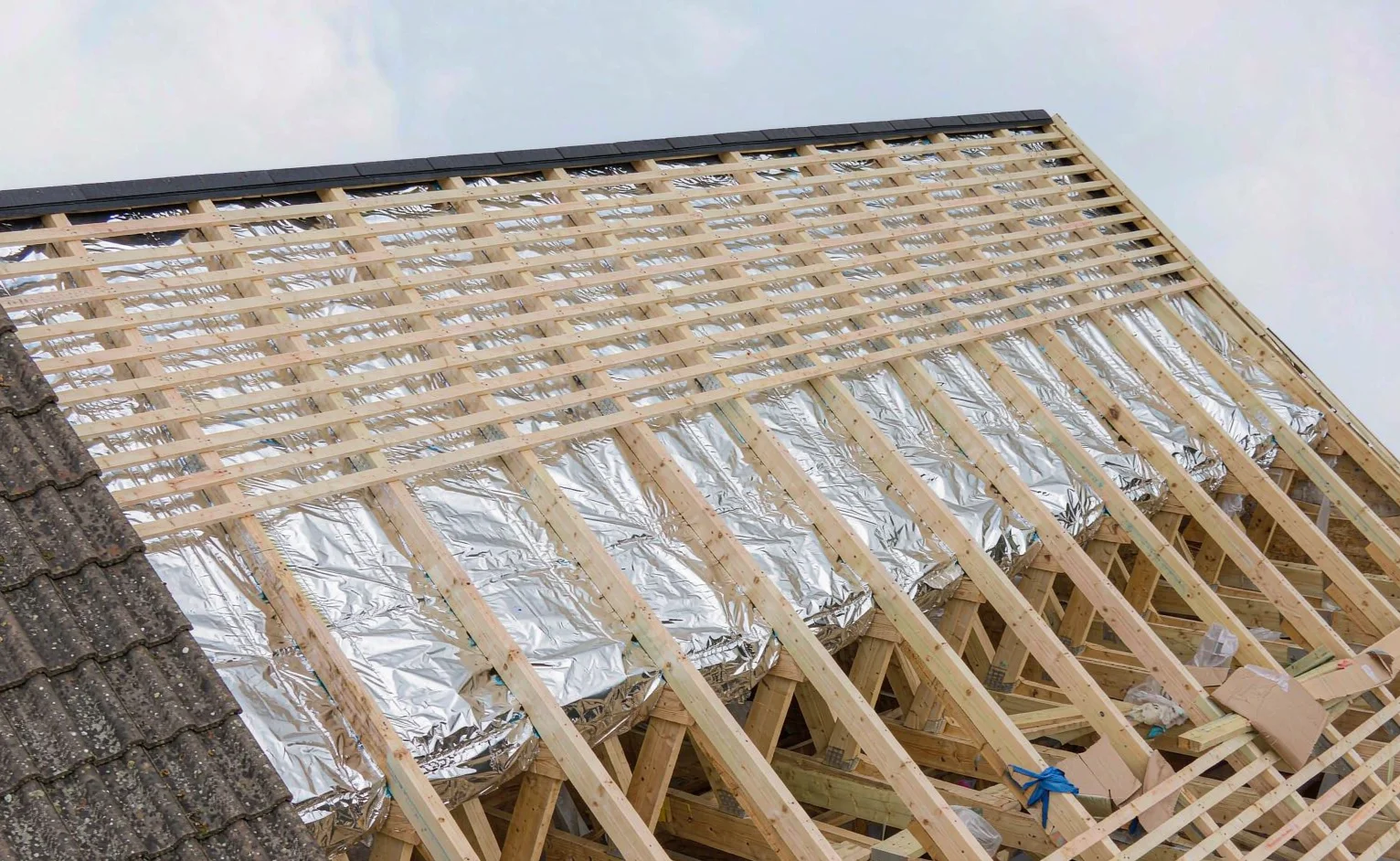
The most expensive roofing mistake in our markets is spec'd at the sheet and lost at the build-up. Two roofs in the same street, same tile, can differ by 8–10°C indoors purely on what sits under the covering. The build-up we quote: a reflective foil radiant barrier under the battens; a ventilated batten cavity with soffit intake and ridge exhaust, so heated air leaves the roof instead of soaking into rooms; and on low-pitch or high-rainfall jobs, a self-adhesive underlayment under the covering as the second line of defence against driven rain. Detailing carries the rest: 316-grade stainless fasteners with bonded EPDM washers within ~10 km of the coast, flashings cut from the same coated steel so dissimilar metals never touch, and gutters sized for the downpour intensity, not the annual average. Indoors, the build-up should meet the ceiling materials in Ceiling Materials for Hot & Humid Climates: Spec Guide, so hot side and finished side work as one system.
The build-up under the covering: reflective foil barrier, ventilated batten cavity and ridge exhaust — this layer decides the indoor temperature more than the tile colour does.
Which roofing system for which climate zone
Zone
Enquiries on file
Recommended system
Critical detailing
Ethiopian & Rwandan highlands (~2,200 m)
247 Ethiopia + 15 Rwanda records
Asphalt shingle or stone-coated metal tile
Hard UV: confirm coating/UV test docs; underlayment for driven rain
South Sudan & Sahel (hot, dusty, seasonal downpours)
59 South Sudan records; 600 sqm villa on file
Stone-coated metal tile / coated steel
Gutters for storm intensity; dust-compatible colours; close before rains
Kenya coast & West Africa (humid, salt, cyclone exposure)
Fix the zone first: altitude and distance from coast decide the system before any colour is chosen.
Ask for documents: SGS and CE test reports on the tile line, not just a colour chart.
Spec the build-up: reflective foil, ventilated cavity, underlayment on low pitches and high-rain sites.
Detail the metals: 316 fasteners near the coast, same-metal flashings, EPDM-washer screws throughout.
Plan for PV: confirm the profile is walkable and drill-friendly before the solar array is priced.
Getting a roof quoted for an African or Gulf project?
Send us the city, the roof area and the building type — a footprint sketch is enough to start. You will get a zone-matched roofing system with its test documentation, the build-up priced with it, and a delivery schedule that beats the rains.
Which roofing material lasts longest in a hot tropical climate?
Stone-coated metal tile on an aluzinc steel base is the most durable pitched-roof option in our file: the 0.4 to 0.5 mm zinc-aluminium substrate resists corrosion for 30 to 50 years, the acrylic-glazed stone surface blocks UV, and the system withstands wind uplift above 120 km/h. Our roofing catalogue carries both stone-coated metal tile and asphalt shingle lines with SGS and CE test documentation. Coastal detailing requirements are covered in West Africa Coastal Specs: Ghana, Nigeria & Sierra Leone.
Do asphalt shingles work in Africa, or do they melt in the heat?
They work at altitude and fail in the lowland. On the Ethiopian highlands around Addis Ababa at roughly 2,200 m, roof surface temperatures stay manageable and a quality shingle delivers its full service life. In lowland and coastal zones where roof surfaces regularly exceed 70 degrees Celsius, shingles soften, lose granules and age in half the catalogue time, so we specify stone-coated metal or coated steel there instead. Zone-by-zone guidance for hot, dusty markets is in South Sudan Building Materials: Specifying for Heat & Dust.
How do I stop a metal roof from turning the rooms below into an oven?
Specify the build-up, not just the sheet: a reflective foil or radiant-barrier layer above the ceiling line, a ventilated batten cavity that lets hot air escape at the ridge, and light-coloured profiles that reflect rather than absorb solar gain. Ventilation removes more heat than any single coating can. The ceiling-side materials that pair with this build-up are set out in Ceiling Materials for Hot & Humid Climates: Spec Guide.
What fasteners and flashings should be used near the coast?
316-grade stainless steel fasteners, screws with bonded EPDM washers, and flashings cut from the same coated steel as the roof so dissimilar metals never touch. Galvanised fixings and plain steel flashings rust out within two to three monsoon seasons on the coast. The same salt-driven specification logic applies to facade openings in Specifying Aluminum Windows & Doors for Hot Climates.