Modern Furniture Design: Frames, Foam and Finish Grades
Published: November 2, 2026
Four decisions taken in the factory decide whether a sofa still looks new in year three.
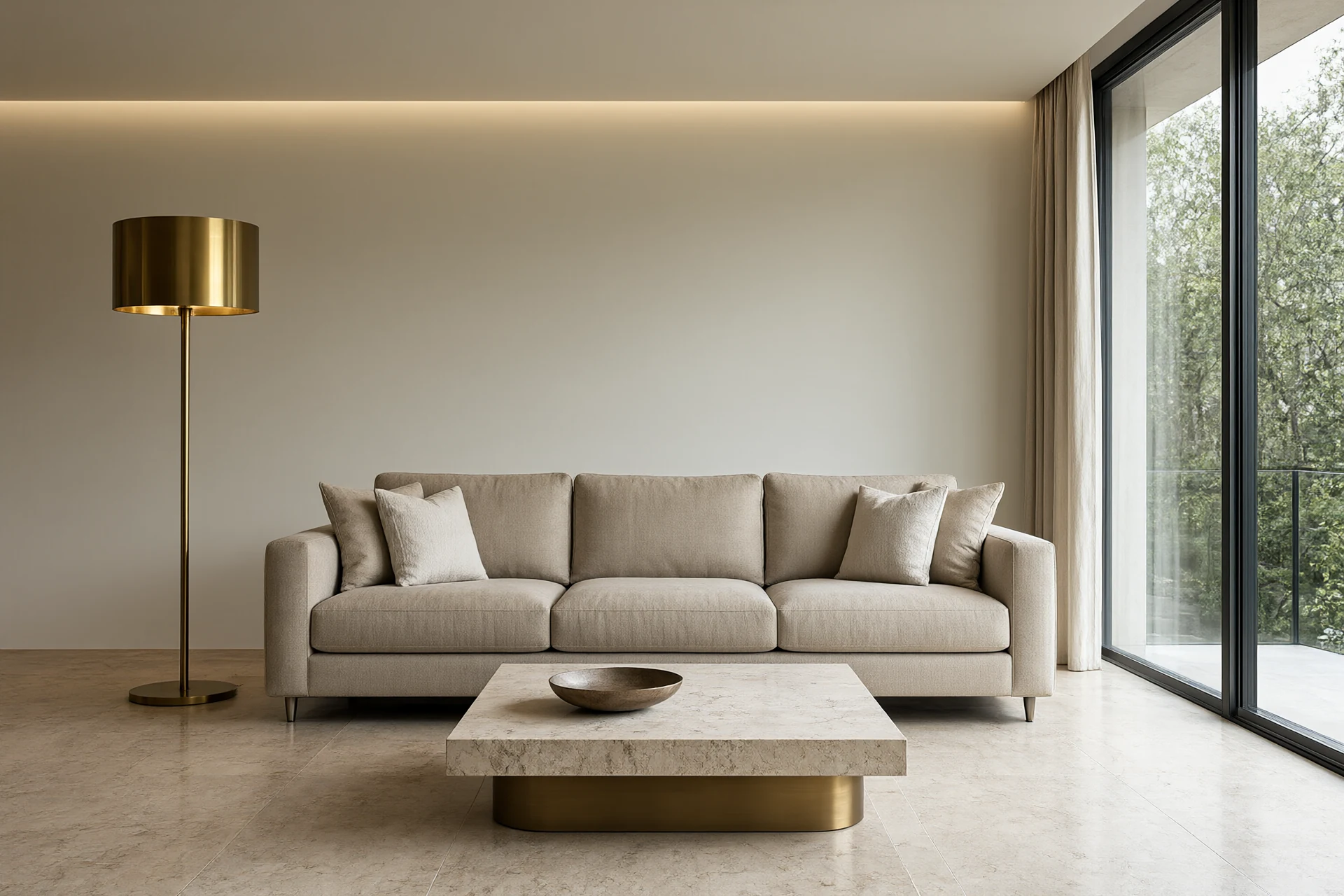
Most furniture bought for a hot-climate house fails at a joint nobody sees, three years after delivery. Modern furniture design that holds up begins with four decisions taken in the factory: the frame species and its moisture content, the way the corners are joined, the density of the foam under the seat, and the thickness of the veneer on the face. Colour, silhouette and the sheen on a table top all sit on top of those four. Across 214 seating, dining and bedroom packages we have built for clients in Kenya, Tanzania, Ethiopia and the Gulf since 2019, the complaints we handled were rarely about style. Frames racked, cushions flattened, edges lifted. The sections below work through each decision in the order it gets made, with the numbers we write into a purchase order. The seating geometry that has to be settled before any of it is ordered sits in our Living Room Interior Design: Layout, Materials and Light.
Modern Furniture Design Begins at the Frame Joint
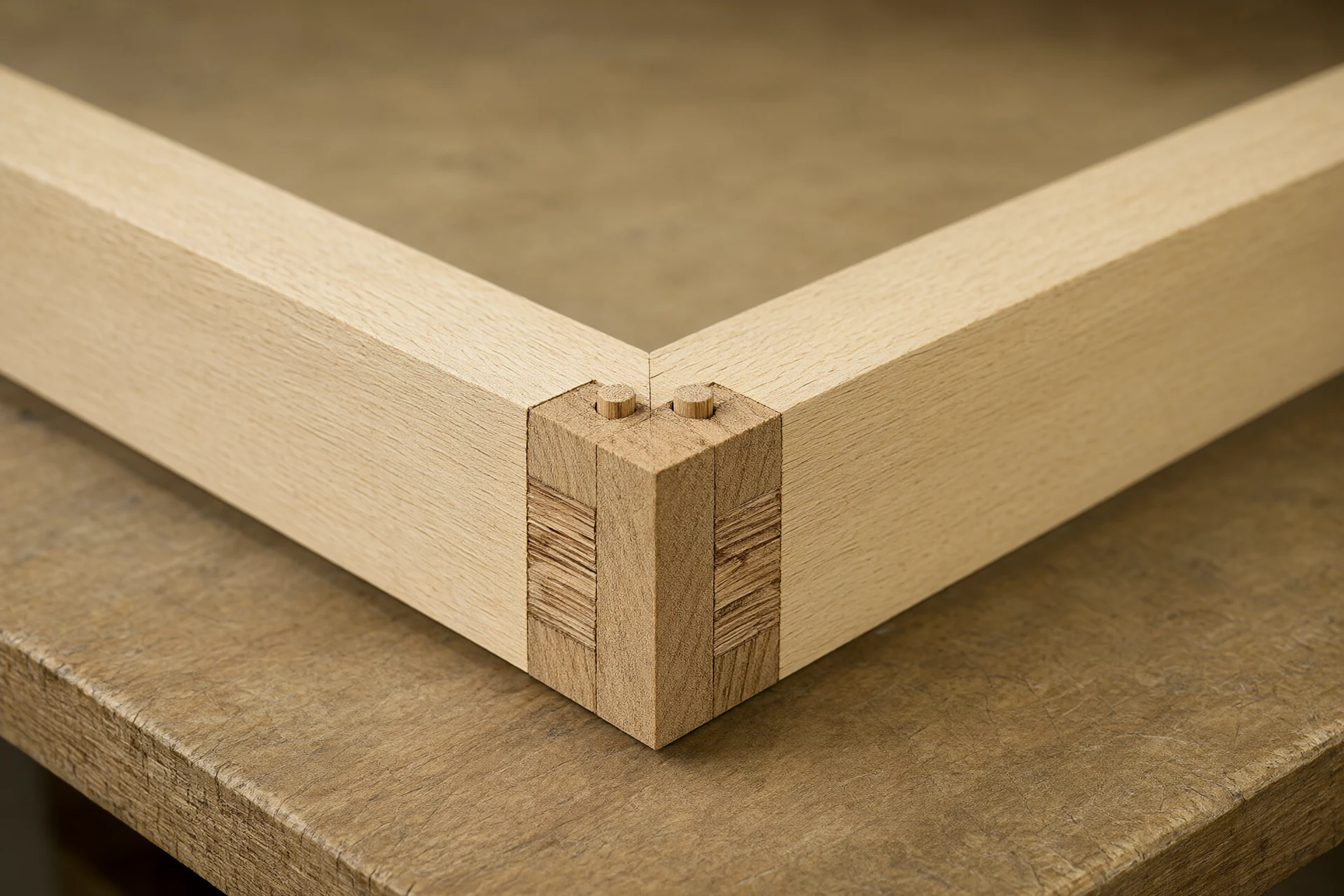
A frame is kiln-dried hardwood at 8 to 10 percent moisture content, measured with a pin meter on the day it is cut rather than the day it was bought. That single number explains most of the failures that reach us. In Mombasa and Dar es Salaam the same timber left in an open workshop climbs to 15 or 16 percent inside a week, and a frame assembled at 16 percent shrinks 1.8 to 2.2 millimetres across a 600 millimetre rail as it dries out in an air-conditioned room. That is enough movement to open every corner in the piece. Corners carry the load, so they get a 40 by 12 millimetre mortise and tenon, cross-linked PVA and two 8 millimetre beech dowels, with a glued and screwed corner block behind. The block takes the racking force, which is why a corner can survive a dropped delivery and still not creak a year later. Screw-only corners are what a USD 300 container sofa uses. They hold for roughly two wet seasons at 80 percent relative humidity. We test one frame per batch by loading 200 kilograms on the front edge of the seat for an hour and measuring deflection; a sound joint returns to zero, a screw-only corner has moved 4 to 6 millimetres and stays there.
Foam Density Decides Whether a Sofa Still Looks New in Year Three
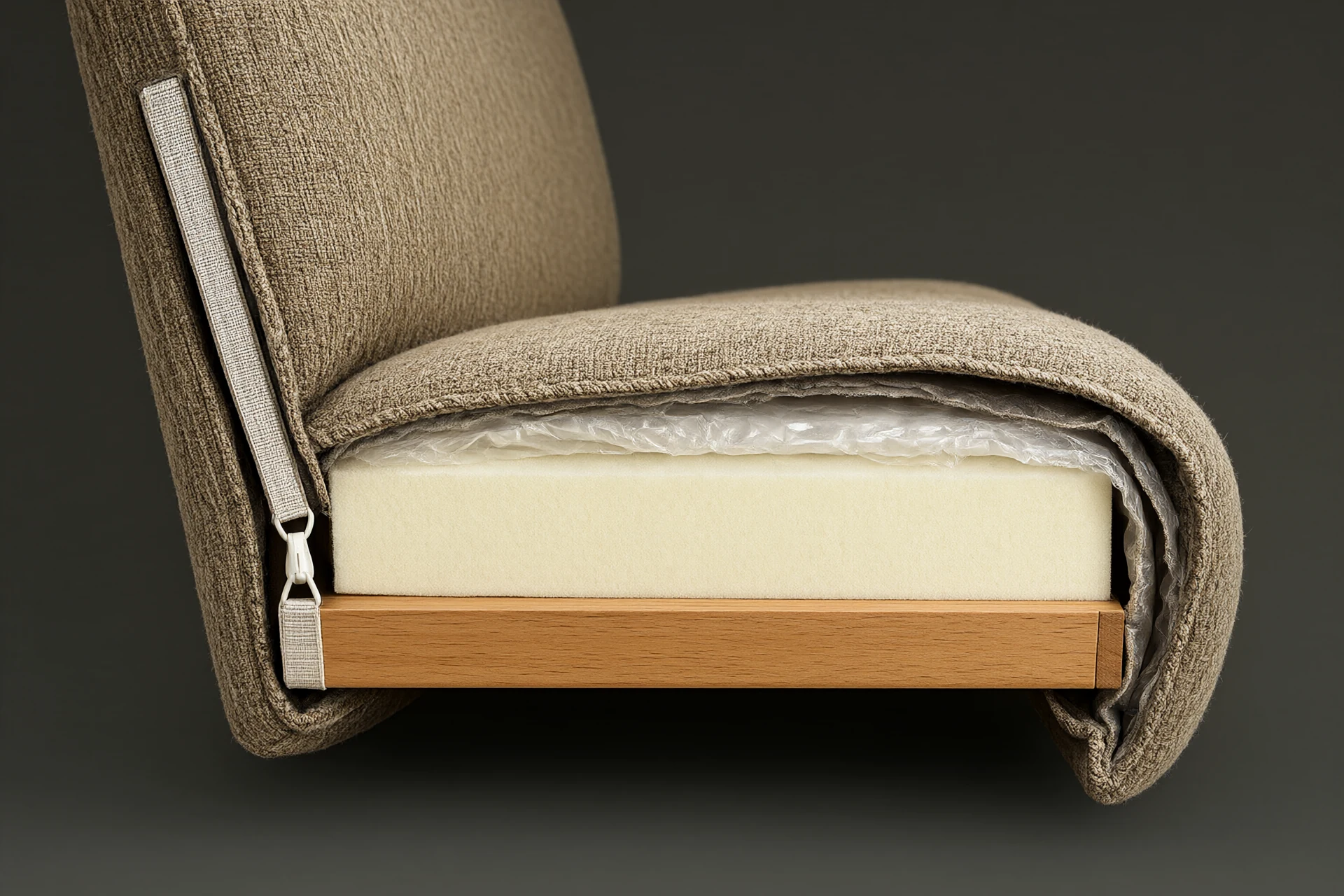
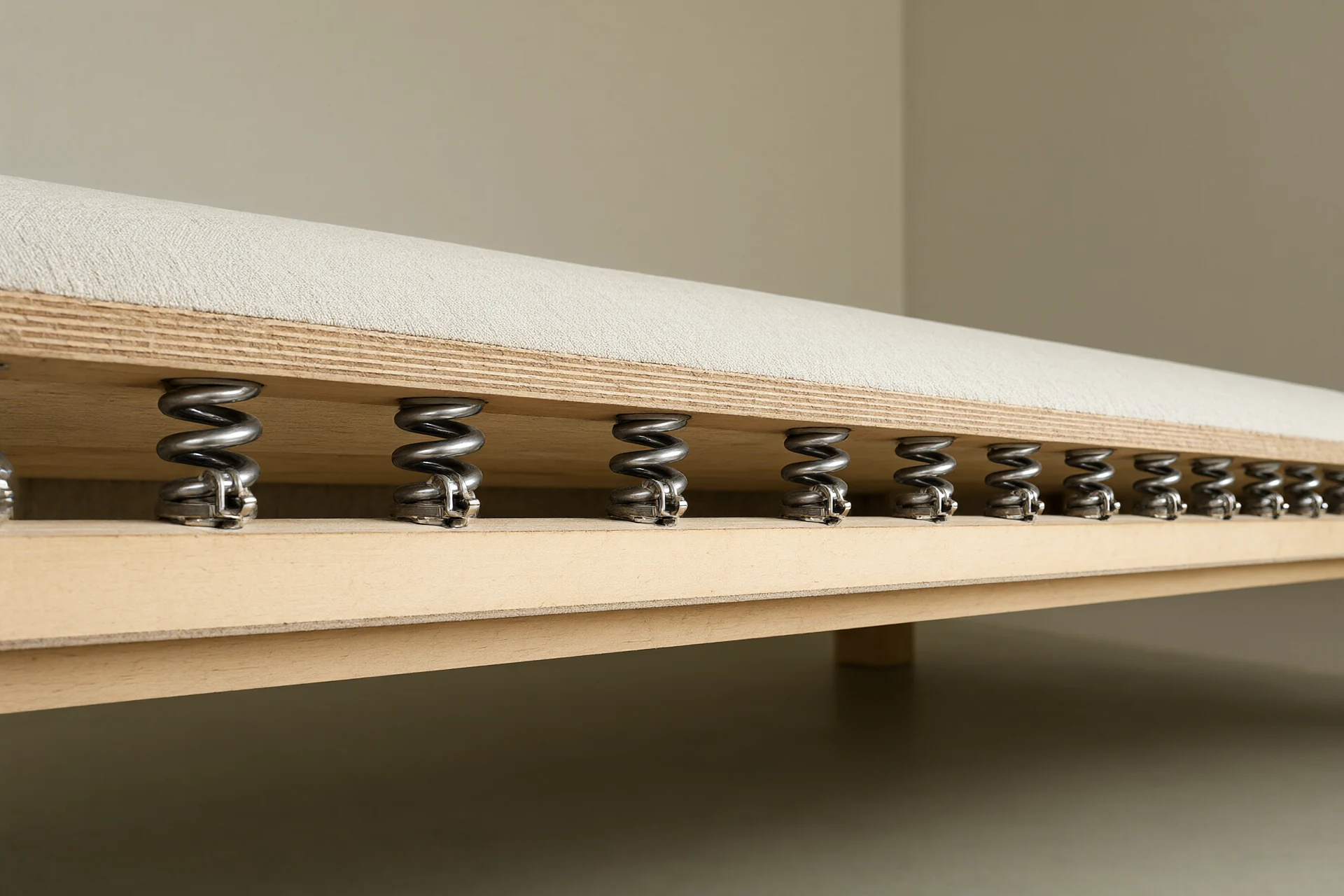
Seat foam is the part clients judge last and feel first. A family sofa needs 35 to 40 kilograms per cubic metre with an indentation load deflection of 35 to 40, and back cushions run lighter at 25 to 28 so they compress when somebody leans back. Anything under 30 in a seat base loses 12 to 15 percent of its height within 18 months of evening use, and once a cushion loses height the cover goes slack and the whole room reads as tired. Compression set matters more than the number on the label; we ask for under 5 percent after 22 hours at 70 degrees. Wrapping changes the feel without changing durability. A 200 gram polyester fibre wrap softens the edge and needs no maintenance, while a feather wrap feels expensive for two years and then needs dressing every morning for the rest of its life. Under the cushion, the deck carries the load. Eight 50 millimetre elastic straps on a hardwood rail support about 90 kilograms across a three seater, and 8 gauge sinuous springs at 100 millimetre pitch do the same job with more resilience and 4 kilograms of extra weight. What neither will survive is a 25 millimetre particleboard rail, which swells 12 to 18 percent at 85 percent humidity and never holds a staple again.
| Component | Spec we write | What fails if it drifts |
|---|---|---|
| Seat foam | 35 to 40 kg per cubic metre, ILD 35 to 40, compression set under 5 percent at 22 h / 70 C | Cushion loses 12 to 15 percent height in 18 months and the cover goes slack |
| Back cushion | 25 to 28 kg per cubic metre, 200 gsm polyester wrap | Foam collapses at the lumbar point and never recovers its shape |
| Seat deck | 8 straps of 50 mm elastic webbing or 8 gauge sinuous springs at 100 mm pitch, hardwood rail | Webbing sags 15 mm by year two and the seat develops a hollow |
| Frame rail | Kiln dried hardwood at 8 to 10 percent MC, no particleboard anywhere in the frame | Rail swells at 85 percent RH and loses every staple |
| Upholstery | Martindale 40,000 on family seating, blue wool 6 light fastness, removable covers | Pile goes bald along the front edge inside two years |
Veneer, Lacquer and Metal on the Surfaces People Touch
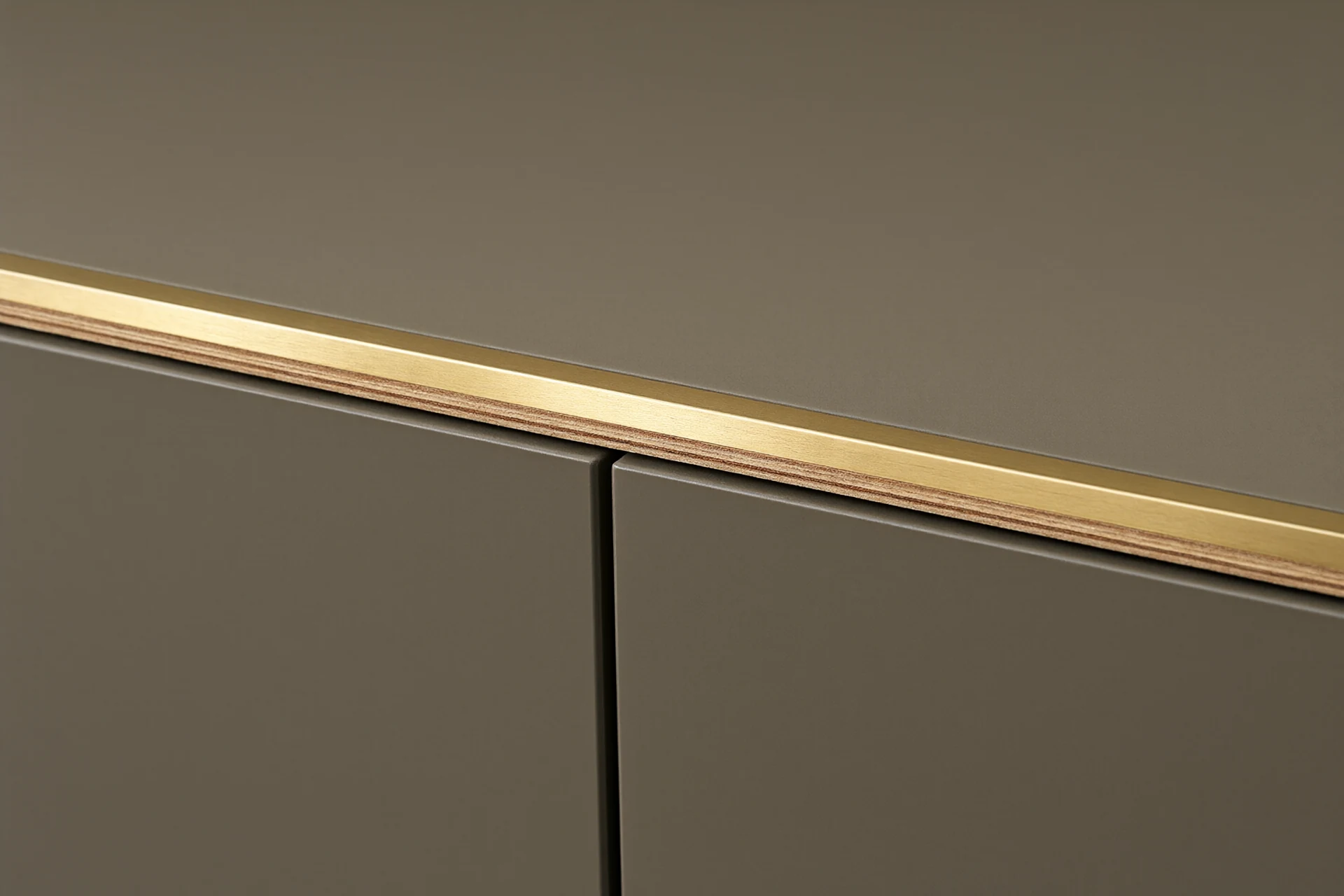
Face material is where a modern piece either looks like furniture or like a photograph of furniture. Walnut veneer goes on at 0.6 millimetres over an 18 millimetre plywood core, sliced from one flitch and sequence matched so the grain runs continuously across a 2.4 metre sideboard front. Anything thinner than 0.5 telegraphs the core through the finish within a season, and paper-backed veneer lifts at the edge the first time a room is cleaned with a damp cloth. Edge banding is 2 millimetres ABS, not the 0.4 millimetre PVC that most export catalogues imply; the thin tape shows a dark line where the glue has crept after two wet seasons. Lacquer choice splits into two. Three coats of polyurethane at 30 to 35 percent solids give a matte finish of 5 to 8 gloss units that hides fingerprints and takes a repair, while five coats of water-based lacquer look cleaner out of the crate and mark permanently the first time a glass is left on them. Metal is the detail that dates a scheme fastest. Brushed brass within 2 kilometres of salt water needs a PVD lacquer, since unlacquered brass goes blotchy in a single season on a coastal balcony. Stone tops work at 20 millimetres honed sintered stone for daily use, and bookmatched marble only where somebody will actually maintain it. The grade comparison across the rest of the room is in our Furniture Materials for Hot-Climate Interiors.
| Surface | Spec we write | Cost signal |
|---|---|---|
| Veneer | 0.6 mm sliced walnut, sequence matched, 18 mm plywood core | Adds 6 to 9 percent to a case good |
| Edge banding | 2 mm ABS, colour matched to the darker grain line | USD 4 to 7 per metre of edge |
| Lacquer | 3 coats PU at 30 to 35 percent solids, 5 to 8 gloss units | Repairable on site, unlike water-based |
| Metal | PVD lacquered brushed brass within 2 km of the sea, 240 grit inland | PVD adds 12 to 18 percent to the metalwork |
| Stone top | 20 mm honed sintered stone, 6 mm shadow gap at the frame | Sintered stone at 40 percent of bookmatched marble |
Modern Dining Room Design and Modern Bedroom Design: The Proportions
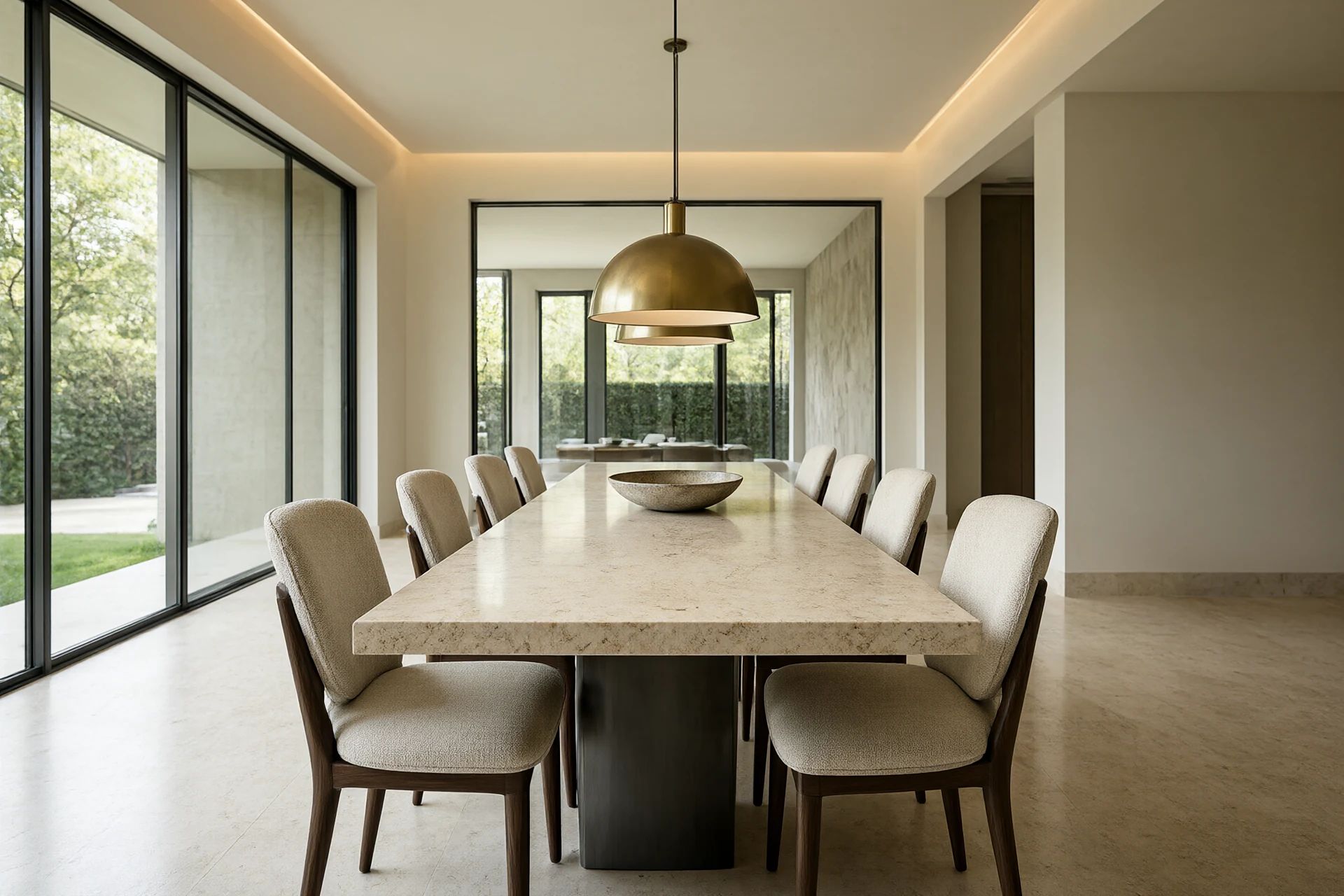
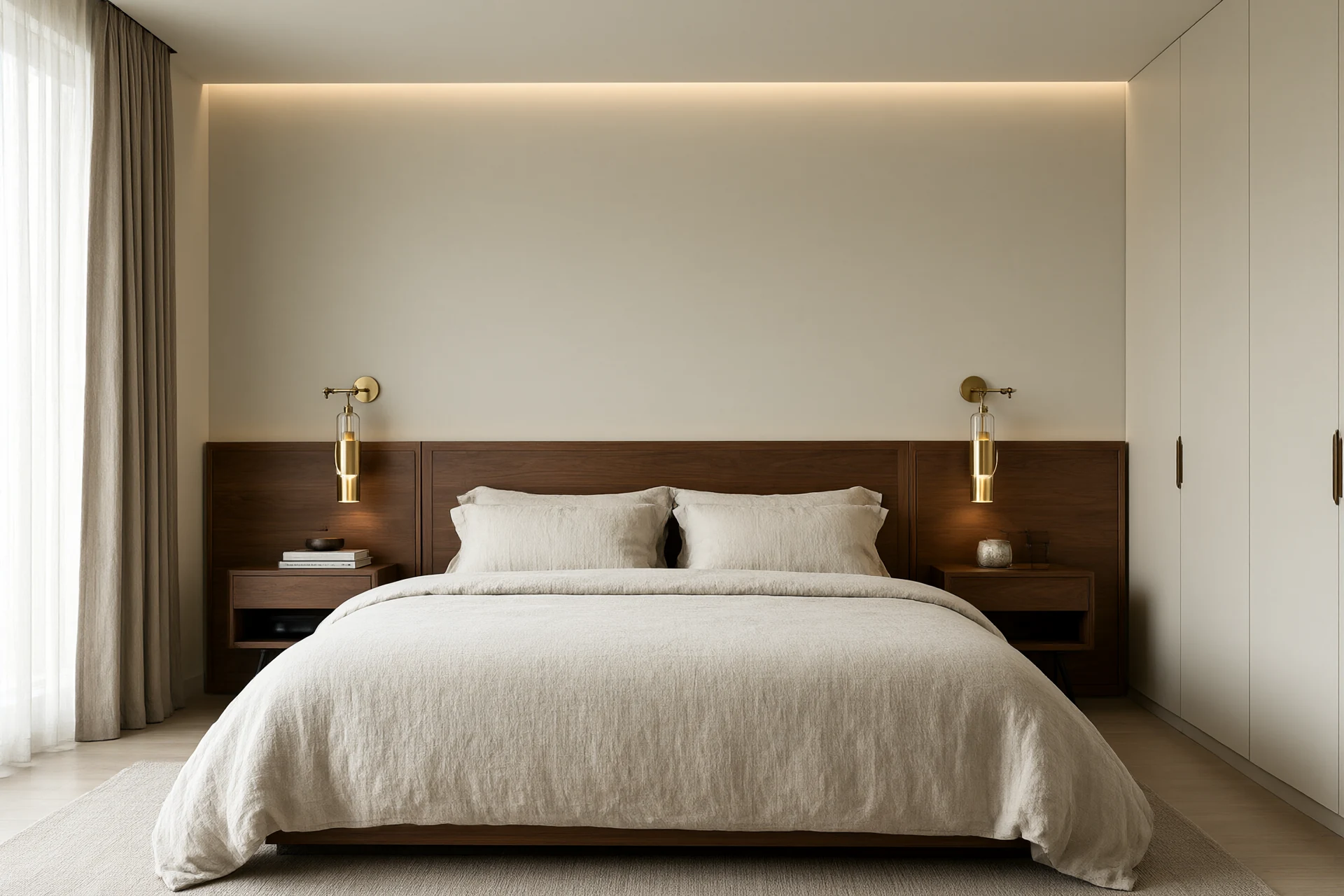
Proportions are cheaper to get right than materials and far more visible when they are wrong. A dining table stands 750 millimetres high with 300 millimetres clear between the seat and the apron, because anything less traps a knee. Each place needs 600 millimetres of depth and 750 to 780 millimetres of width, so a six seater is 2,100 by 1,000 and a round table of 1,500 takes six without elbows touching. Allow 900 millimetres behind each chair to push back, and 1,050 millimetres where a server walks behind the row. Modern dining room design fails most often on the last two numbers, because a table bought to fill a room leaves no lane for a chair. Bedrooms run on similar arithmetic. A 1,800 by 2,000 mattress needs 600 millimetres on both sides to make the bed, 700 millimetres of walkway at the foot, a headboard 1,100 to 1,200 millimetres from the floor, and nightstands 450 to 500 millimetres wide with the top at 550 to 600. Below 14 square metres the mattress drops to 1,600 wide and the nightstands to 400, and the room still works.
Cost, Container Volume and the Twelve-Month Check
Prices below are FOB Foshan for the specification described above, in quantities of one container. A three seater sofa runs USD 390 to 720, a two seater 300 to 540, an armchair 180 to 320, so a three plus two plus one set lands at USD 870 to 1,580 before fabric upgrades. A six seater dining set with an upholstered chair is 780 to 1,650, a queen bed with a walnut headboard 420 to 1,050, and a full four bedroom package 9,000 to 18,000. The volume matters as much as the price. Knock down packing takes that three plus two plus one set from 8.6 cubic metres assembled to 5.2 packed, and a 40 foot high cube holds 68 cubic metres, loading to about 60 usable. One container therefore carries a full villa with room left for lighting and mirrors. Production runs 45 to 60 days after sample approval, sea freight to Mombasa 25 to 32 days, installation 10 to 14. The twelve-month list is short and worth writing into the handover pack: rotate and flip cushions monthly, tighten frame bolts at month three rather than month twelve, re-check webbing sag after the first wet season, oil walnut every 12 to 18 months, and inspect the brass lacquer annually on any coastal project. Clients who buy the whole house in one order tend to keep that schedule, because one packing list makes it obvious what went where. The sequence for doing so is in our Whole-House Material Packages: What 63 Enquiries Ask For, and the finishing layer above the furniture is in our Interior Decoration Ideas: The Finishing Layer That Lasts.

- Frame moisture content measured at 8 to 10 percent on the day of cutting, not on the delivery note.
- 40 by 12 millimetre mortise and tenon corners with a glued corner block, no screw-only frames.
- Seat foam 35 to 40 kilograms per cubic metre, compression set under 5 percent.
- Webbing or springs fixed to a hardwood rail, never particleboard.
- 0.6 millimetre sequence matched veneer and 2 millimetre ABS edge banding.
- Matte PU lacquer at 5 to 8 gloss units, repairable rather than sealed.
- 900 millimetres behind every dining chair, 600 millimetres either side of the bed.
- Knock down packing confirmed before the freight is quoted.
Planning a furniture package?
Send the room schedule, the door and window plan and the seat count. We return a frame and foam specification, a finish schedule with gloss and edge details, a container loading plan and one packed order.
Request a Furniture Package →Frequently asked questions
Is factory-direct furniture cheaper than local retail for a villa?
Yes, by 35 to 55 percent on the same specification. A three seater sofa that retails at USD 980 to 1,400 in Nairobi leaves our Foshan factory at USD 390 to 720, and the gap widens on upholstered dining chairs where retail marks up twice. Freight takes back 8 to 12 percent of the saving on a 40 foot container, so the net gain sits near 30 to 45 percent. The comparison only holds when the specification is written down in the same terms, which is what our Whole-House Material Packages: What 63 Enquiries Ask For sets out.
What furniture survives heavy villa guest use?
Kiln dried hardwood frames at 8 to 10 percent moisture content joined with 40 by 12 millimetre mortise and tenon corners, seat foam at 35 to 40 kilograms per cubic metre, and upholstery at Martindale 40,000 or above. On the surfaces, PVD lacquered brass and honed stone cope with daily cleaning; unlacquered brass and polished marble do not survive two seasons of it. The full grade comparison is in our Furniture Materials for Hot-Climate Interiors.
What container size fits a villa furniture order from China?
A four bedroom villa with living, dining and outdoor seating packs into one 40 foot high cube, which holds 68 cubic metres and loads to about 60 usable. Knock down packing brings a three plus two plus one sofa set down to 5.2 cubic metres from 8.6, so the container also takes dining, beds and case goods. A single 20 foot container at 33 cubic metres only suits a one bedroom apartment fit out. Room by room volumes are listed in our Living Room Interior Design: Layout, Materials and Light.
How do I spec one furniture range for all villa rooms?
Fix three variables across the house and let everything else move: one frame family in the same hardwood, one metal finish, and one wood tone, with fabric allowed to vary by room. Six to eight SKUs then cover a four bedroom villa without any room looking borrowed from another scheme. Keep the outdoor pieces in a separate family, because the finish system differs. Fabric selections that hold up across all of them are compared in our Soft Furnishings for Hot Climates: Blinds & Carpet guide.
What lead time for a multi-unit villa FF&E package?
Forty five to sixty days for production once shop drawings and fabric approvals are signed, then 25 to 32 days of sea freight to Mombasa and 10 to 14 days of installation. Budget 90 to 110 days from approval to handover. The two approvals that stall projects are the frame sample and the fabric strike off, so both should be closed before the purchase order is issued.
Can one supplier deliver furniture, lighting and decor for a villa?
Yes, and it is usually cheaper than splitting the order. One supplier means one packing list, one container, one customs entry and one party responsible when a lamp arrives with a cracked diffuser. In our packages lighting and mirrors add 3 to 5 cubic metres to a villa container, which rarely changes the freight cost. The palette logic that ties the three together is explained in our Modern Interior Design: The Warm-Climate Spec Guide.