Contemporary Home Decor: Object Counts, Scale and the Edit
Published: November 6, 2026
Decor is the last five percent of a budget and the first thing a visitor reads. It is settled by counts, heights and one metal, not by how many shops you visit.
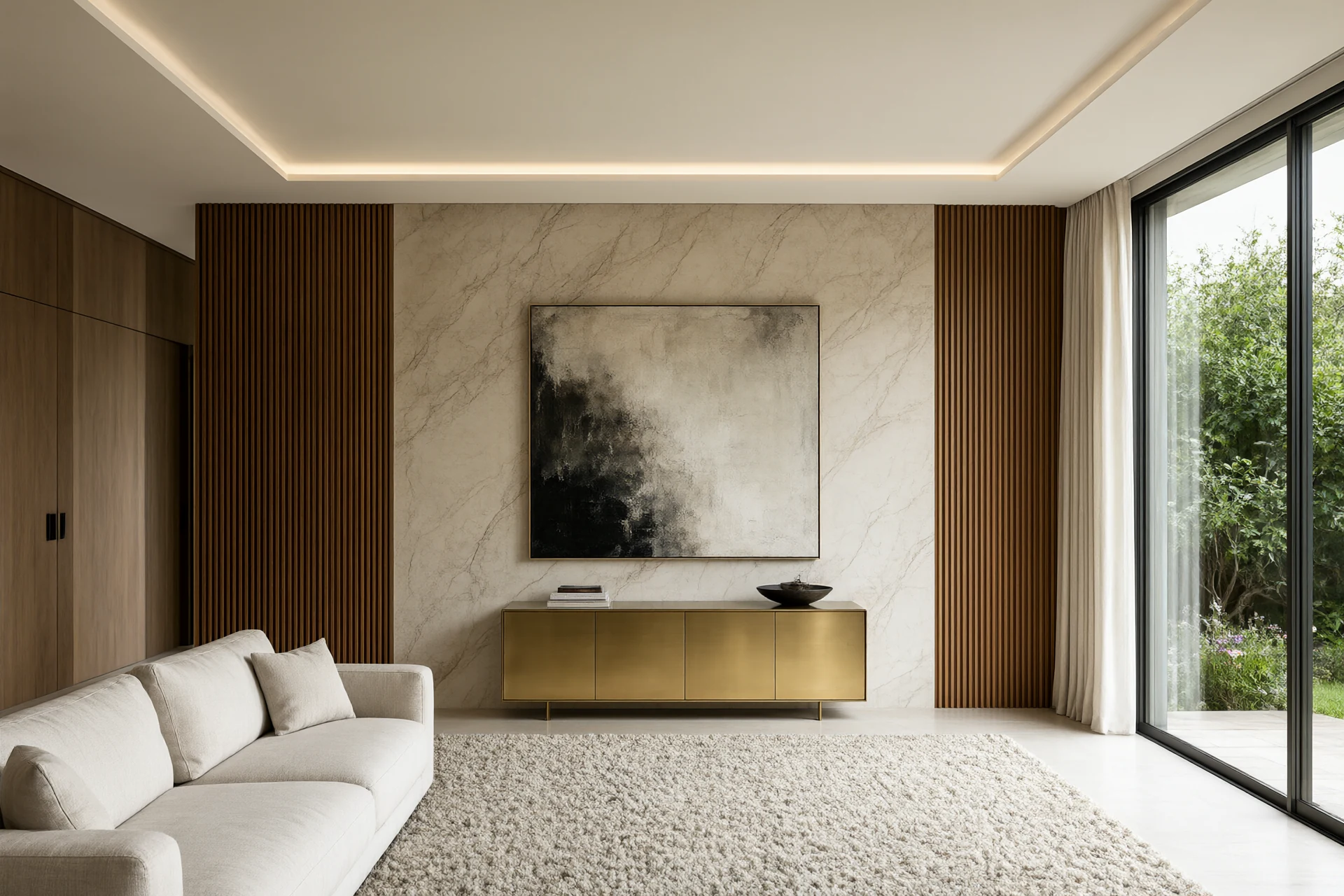
A room looks expensive or looks staged within two seconds, and the difference is arithmetic. Contemporary home decor is usually treated as a shopping problem. It is a counting problem. Three objects on an 1,800 millimetre console, a canvas at 60 to 75 percent of the sofa width, three cushions on a 2,200 millimetre seat, and one metal repeated five times across the room. Add a fourth object and the console reads as a market stall. Buy a canvas at 40 percent of the sofa and the wall above it looks empty however good the print is. Our enquiry log carries 596 projects since 2019, of which 102 are villas, 46 apartments and 86 home fit-outs, and the decor stage is where a finished shell most often stalls, because the last 5 percent of the budget has no drawing behind it.
Contemporary Home Decor Begins With What You Leave Out
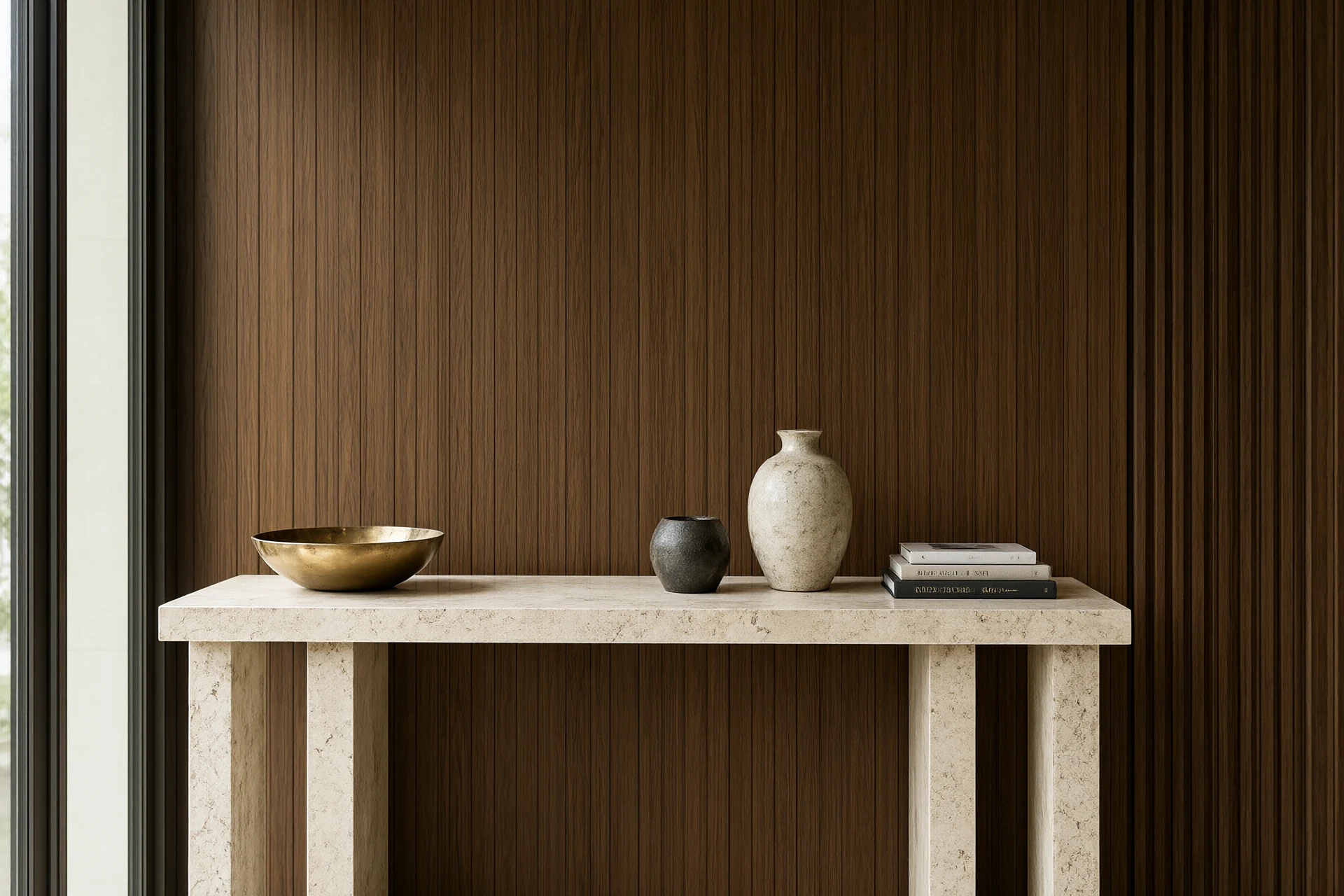
Start from the surface, not the object. An 1,800 millimetre console carries three pieces and one low stack of books, with the tallest piece at 450 to 600 millimetres so it never competes with the art above it. Group them as two and one rather than an even row, keep the total footprint under 40 percent of the top, and let the empty 60 percent do the work. The rule scales down: a 1,200 millimetre sideboard takes two objects, a 450 millimetre side table takes one, a coffee table takes a tray of 400 by 400 millimetres and nothing loose. Height is the second count. Put a 200, a 350 and a 500 millimetre piece in the same group and the eye reads a composition. Put three pieces at 300 millimetres and the group reads as stock. Materials follow the room rather than the season: honed travertine, matte ceramic, brushed brass, and one dark timber. Gloss and chrome are what make a scheme look dated by year three in a hot climate, because both hold fingerprints and salt film. The wider palette logic sits in Modern Home Design: One Palette From Entry to Bedroom.
| Surface | Objects | Height range | Footprint |
|---|---|---|---|
| Console, 1,800 mm | 3 + one book stack | 200 / 350 / 500 mm | Under 40 percent |
| Sideboard, 1,200 mm | 2 | 250 and 400 mm | Under 35 percent |
| Coffee table | One 400 mm tray | Under 120 mm | One third |
| Side table, 450 mm | 1 | 300 to 450 mm | One third |
| Shelf, 2,400 mm | 7, with one third empty | Under one third of shelf height | Two clusters |
Art Scale Against the Sofa, Not the Wall
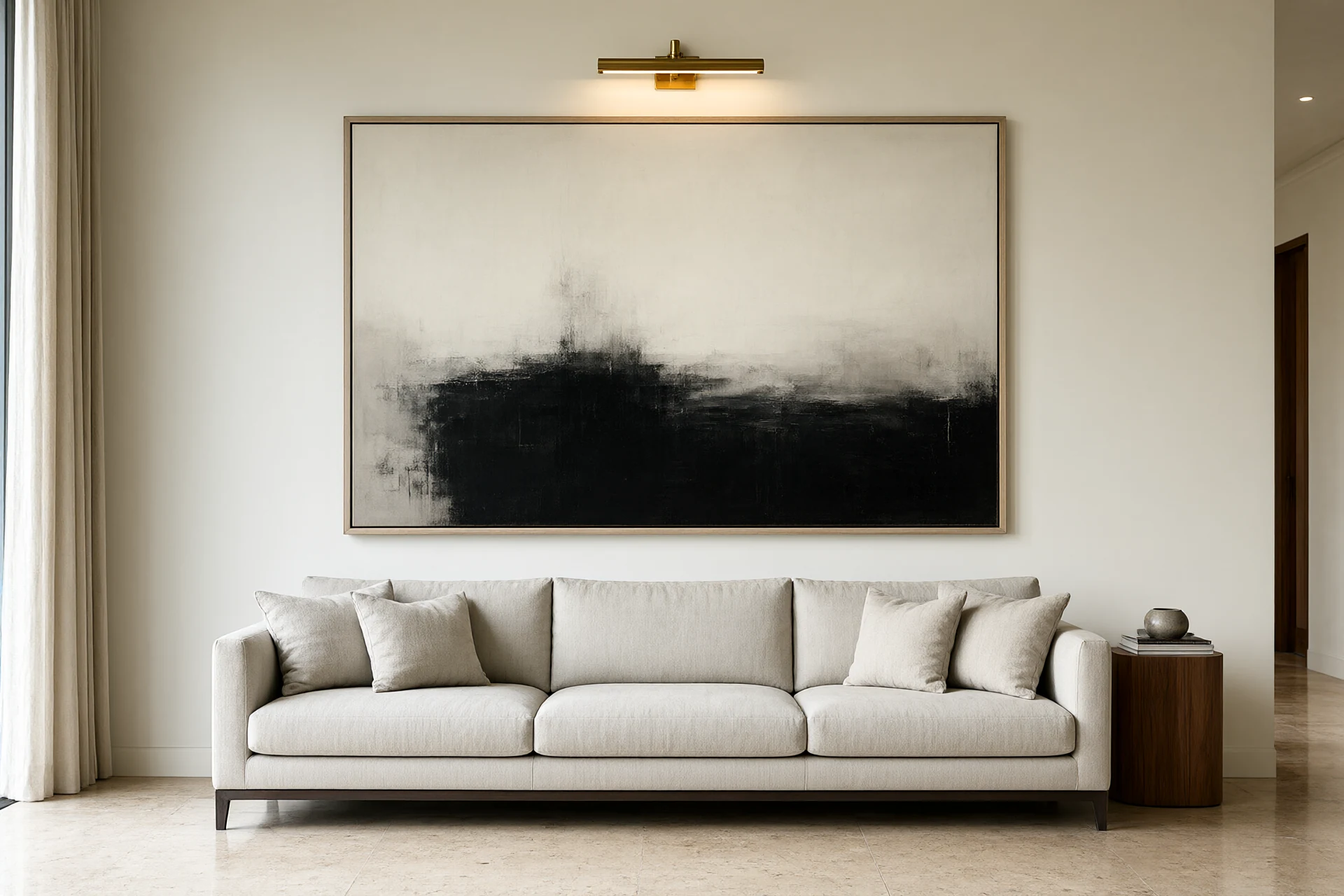
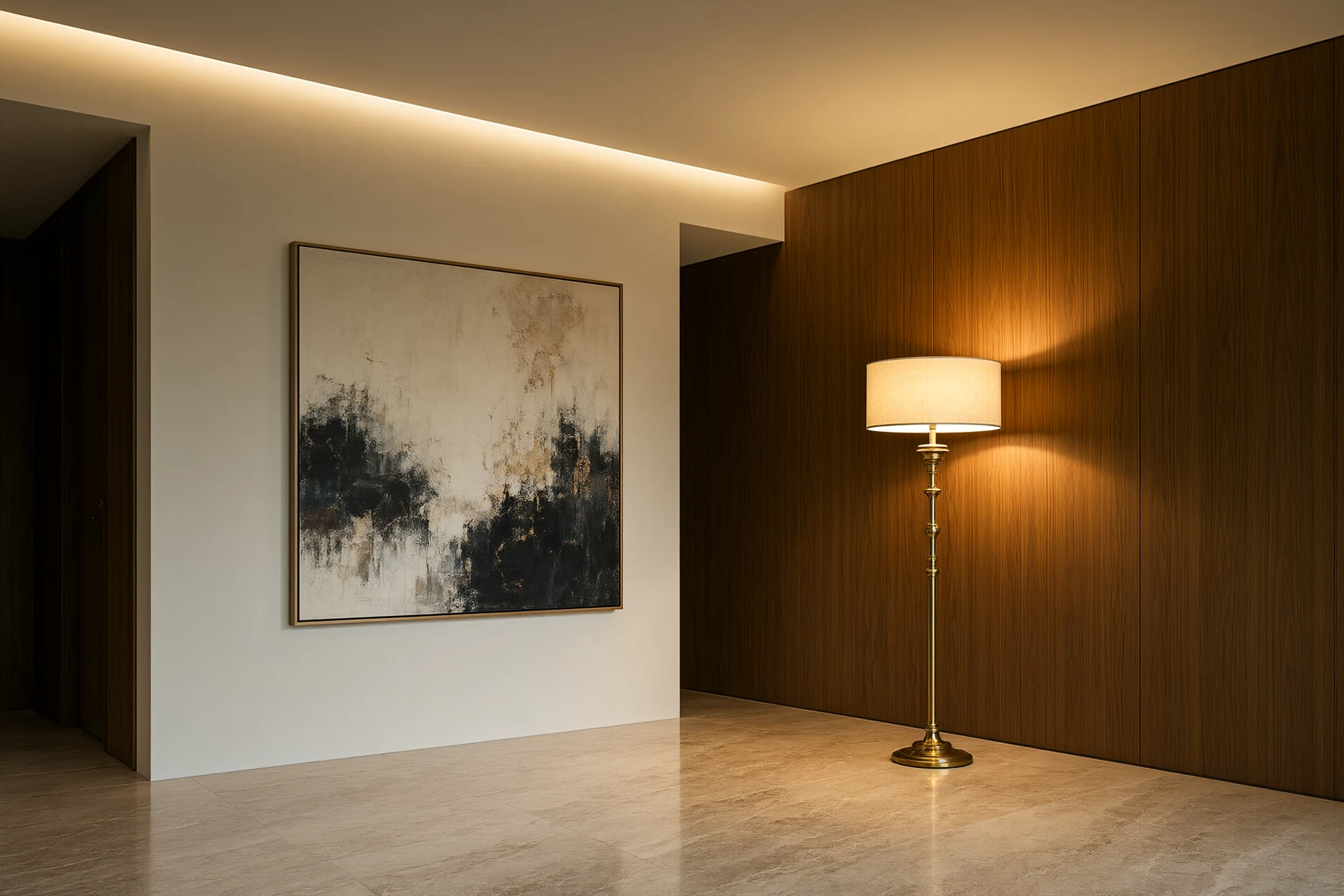
Art hung to the wall always looks small. Hang it to the furniture. A single canvas over a sofa should run 60 to 75 percent of the sofa width, so a 2,400 millimetre sofa takes a 1,500 to 1,800 millimetre canvas rather than the 900 millimetre print that gets bought by default. Centre the piece at 1,450 to 1,550 millimetres from the floor, keep the bottom edge 200 to 250 millimetres above the sofa back, and leave the top free by at least 300 millimetres so the ceiling still reads. Diptychs and triptychs work on a long wall, provided the total width follows the same rule and the gap between panels stays at 60 to 100 millimetres. Two stacked pieces are the exception, used where the wall is 3,400 millimetres or taller. Frame matters more than the print. A 20 millimetre walnut float frame and museum glass cost about the same as a wide moulded frame and read quieter in a contemporary room. Avoid non reflective acrylic on a west window wall, since it scratches at the first clean. Where the wall is travertine or fluted timber, a picture light on a 300 millimetre arm keeps the beam off the texture and puts it on the canvas.
Rug, Cushion and Fabric Discipline
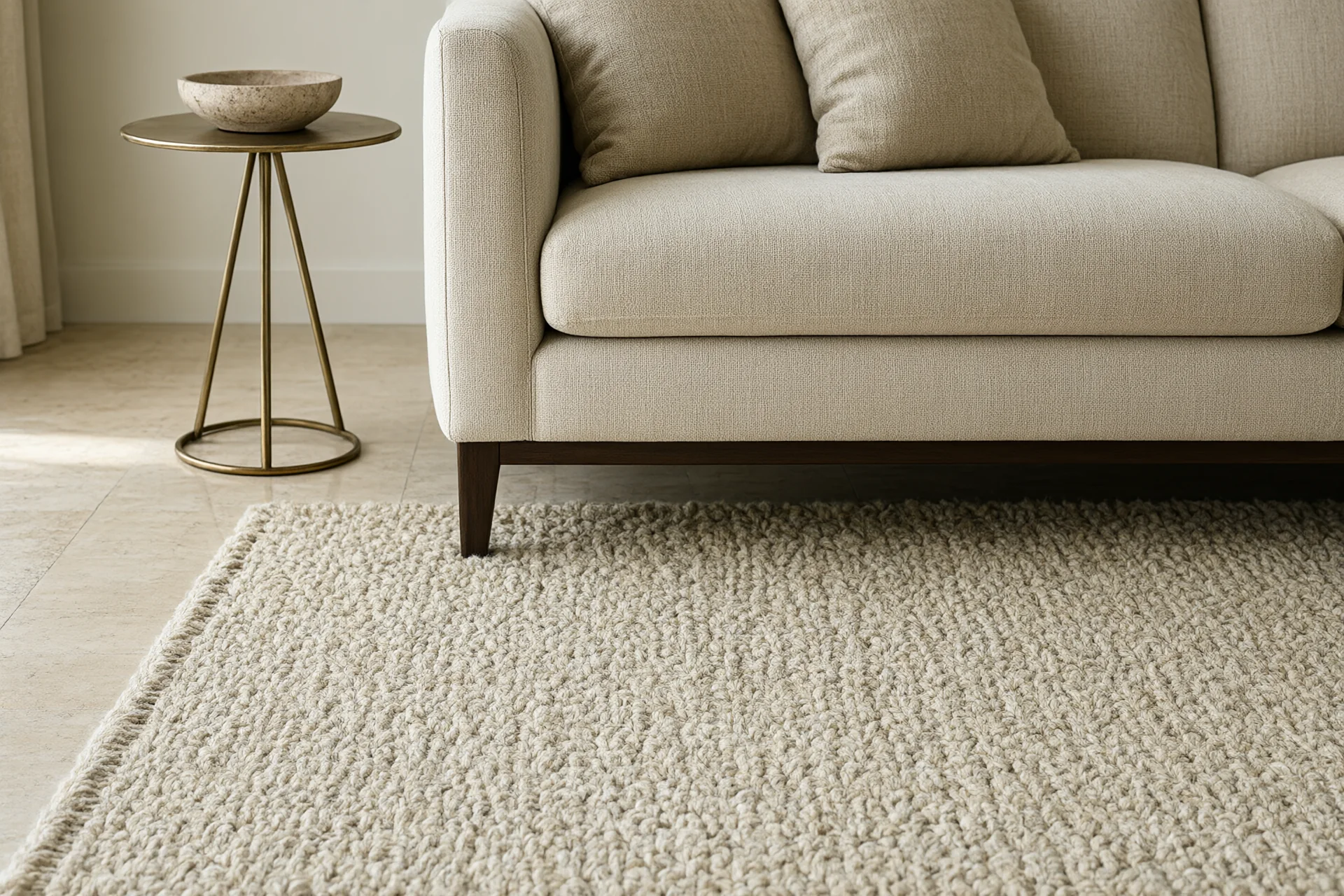
A rug that floats in the middle of a room makes the seating look borrowed. The front 200 to 250 millimetres of every sofa leg should sit on the pile, and the rug should run 300 to 450 millimetres beyond the sofa at each end. For a 2,400 millimetre sofa and a 900 millimetre coffee table, that means 2,700 by 1,800 millimetres, or 2,400 by 1,700 where the room is tight. Wool at 1,200 to 1,500 grams per square metre holds a vacuum line and survives a household; viscose feels softer for a season and then crushes flat under a chair. Cushions are counted, not collected. Three on a 2,200 millimetre sofa, at 600, 550 and 450 millimetres, with one 50 millimetre contrast edge, is the ceiling before the seat stops being usable. Armchairs take one, benches take none. Fill at 35 to 40 kilograms per cubic metre for a seat that keeps shape, and choose a removable cover in a hot climate, since a fixed linen cushion in a 70 percent relative humidity room grows a damp smell by the second rainy season. Colour is the cheapest correction. Keep the rug one value away from the floor, the cushions one value away from the sofa, and put the contrast in a single object rather than in five. Layer counts, blind specification and cleaning intervals are set out in Soft Furnishings for Hot Climates: Blinds & Carpet.
Three Light Layers and One Colour Temperature
Decor dies under a single ceiling grid. Three layers fix it: ambient at 100 to 150 lux for a living room, task at 300 lux where someone reads or cooks, and accent at roughly three times the ambient level on the object you want seen. The accent is what makes brass read as brass rather than as yellow paint, and it is the layer most projects leave out. Colour temperature stays at 2,700 K in living and bedroom areas and 3,000 K in kitchens and bathrooms, with CRI 90 or better, because a 4000 K tube turns travertine grey and turns walnut orange. Dimmers must be trailing edge and rated for the lamp load, since a leading edge dimmer on a 6 watt LED flickers at the bottom of its range and shortens the driver life. Cove light runs at 10 to 15 percent of total output and carries the evening, which is why a 2,700 K strip in a plaster cove beats four recessed downlights on a dimmer. Wall washing matters in a decor scheme. A 24 to 36 degree beam set 400 to 600 millimetres off the wall grazes the texture and gives the fluting a shadow line. Circuit counts and switch heights are covered in Lighting & Switches for Hot Climates: The LED Spec Guide.
The Edit: Shelf, Mantel and the Year Five Check
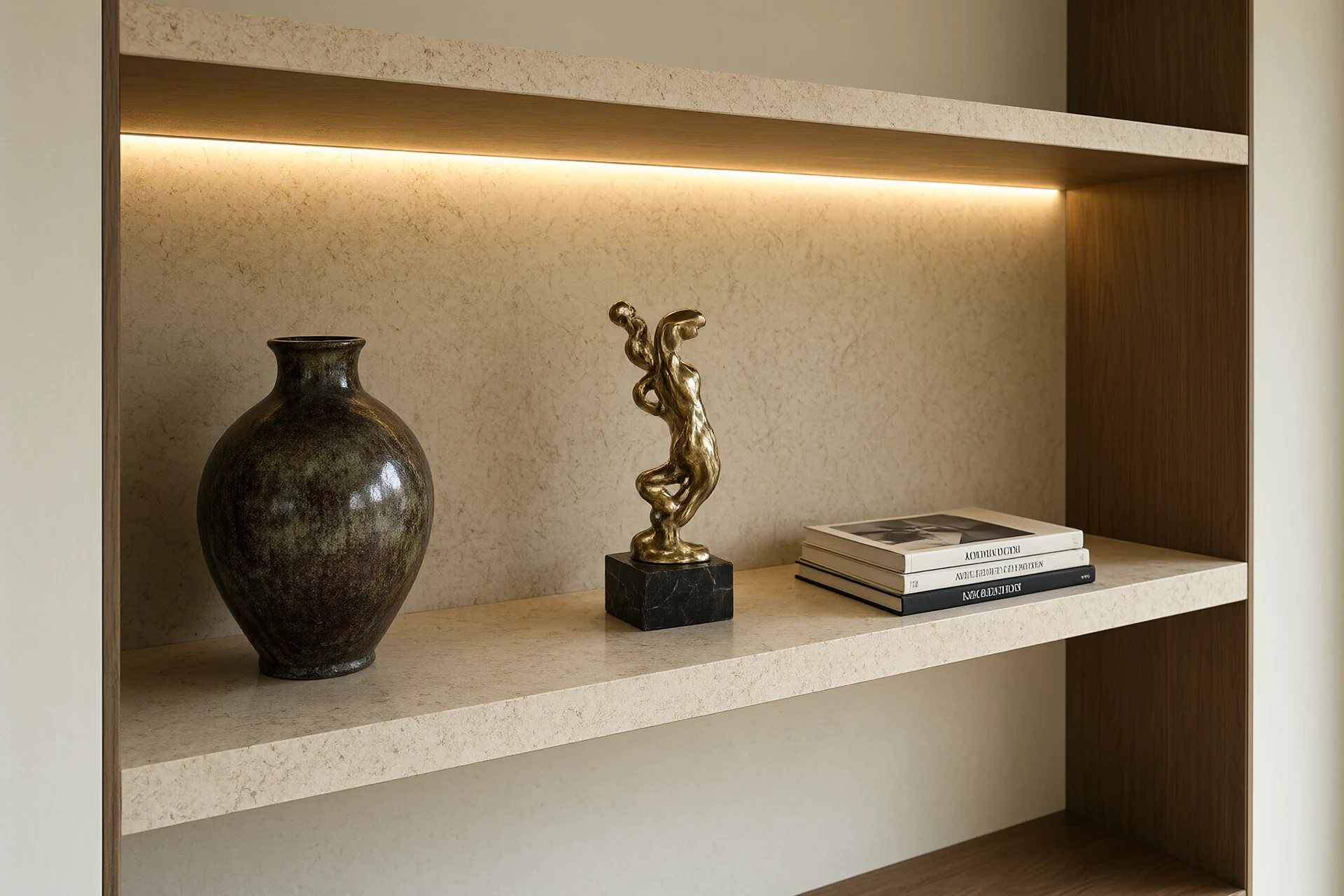
Shelf styling fails on even spacing. Work in two clusters, leave one third of the run empty, and keep every object under one third of the shelf height so the joinery still reads as joinery. A 2,400 millimetre shelf takes seven pieces, six books laid flat in two stacks of three, and one empty bay at the end. Repeat one material three times across the run (ceramic, then brass, then ceramic) and vary only the height. Books belong flat, never vertical and never colour coded, because a vertical row at the end of a shelf becomes a library and stops the eye. Mantels follow the same count with one addition: nothing above 600 millimetres if a mirror hangs over it. Mirrors are placed, not scattered. One per room at most, at 0.6 times the width of the console beneath it, and never opposite a window that faces west, since the reflection doubles the glare at four in the afternoon. The year five check is short. Re-lacquer brass that has gone dull in salt air, have wool rugs washed rather than steam cleaned, replace any cushion fill that has lost 20 percent of its loft, and re-hang art that has drifted on a nylon cord. A decor scheme that passes those four still looks intentional at year five, and that is the whole test. The finishing layer that survives a decade is set out in Interior Decoration Ideas: The Finishing Layer That Lasts, and the seating clearances that decor must not eat into are in Modern Living Room Furniture: Seating Counts and Clearances.
- Three objects on an 1,800 millimetre console, grouped two and one.
- Art at 60 to 75 percent of the sofa width, centred at 1,500 millimetres.
- Rug 300 to 450 millimetres beyond each end of the sofa, front legs on the pile.
- Three cushions on a 2,200 millimetre sofa, fill at 35 to 40 kilograms per cubic metre.
- Ambient 100 to 150 lux, task 300 lux, accent three times ambient, all at 2,700 K.
- Seven objects on a 2,400 millimetre shelf, one third left empty.
Furnishing a villa or an apartment from the shell up?
Send the floor plan and one photograph of the room as it stands. We return a decor schedule with object counts per surface, art sizes, rug dimensions, the light layout and a landed price for the package.
Request a Decor Schedule →Frequently asked questions
How do I get a coordinated material and furniture palette for a villa?
Fix three materials and one metal before anything is bought, then repeat them in every room. Travertine on the floors and the console tops, fluted walnut on the joinery, linen on the seating, and brushed brass on handles, sconces and picture lights. Write the schedule by material rather than by product code, so a change of supplier at the third container does not change the room. We keep a physical sample board of the four finishes and photograph it under 2,700 K light, because a palette approved under a cool office tube reads yellow in a living room.
Can one supplier deliver furniture, lighting and decor for a villa?
Yes, and one supplier is the reason a villa holds its palette. We build the seating and case goods, specify the decorative lighting, and source the objects, rugs and art framing against the same sample board. The consolidation matters more than the discount, because a villa package of 38 to 45 cubic metres ships as one 40 foot high cube instead of four part loads. Lead time runs 45 to 60 days for production and 25 to 32 days of sea freight to Mombasa or Djibouti, with one sample room approved before the balance is released.
How do I avoid style drift across a big apartment fit-out?
Drift comes from three decisions taken late, being the metal finish, the timber tone and the object scale. Lock them in a one page decor schedule before the first order: brushed brass, one walnut stain at 5 percent sheen, and object heights in three bands of 200, 350 and 500 millimetres. Then photograph the first finished apartment from four corners and attach those images to every later purchase order. In 46 apartment enquiries we have handled, the projects that drifted were the ones that approved finishes room by room rather than as one schedule.
What container size fits a villa furniture order from China?
A furnished four bedroom villa lands between 38 and 45 cubic metres, which is one 40 foot high cube at 67 cubic metres usable. Sofas and mattresses ship upright and take the height, so a high cube beats a standard 40 foot by about 8 cubic metres of effective stow. Keep rugs rolled, not folded, and crate art separately with a 25 millimetre ply face. If the order includes stone tops, add 1.2 tonnes of payload and brace the crates for a mixed load, because a stone crate shifting in heavy weather is the usual insurance claim.
Can a supplier keep a consistent finish across apartment phases?
It holds when the finish is written as a specification rather than a catalogue number. Reserve one veneer batch and one powder coat batch for the whole development, agree a 5 percent sheen on lacquer and a 1.5 percent on brass, and keep 5 percent of the order as attic stock. Phase two then matches phase one even if the original line has been discontinued. Ask for the batch reference on the packing list, since a different batch is visible at the joint between two apartments long before it is visible inside one.
What lighting and decor scheme fits a restaurant brand?
Build the scheme around the table, not the ceiling. Pendants at 700 to 800 millimetres above the top, a 2,400 K to 2,700 K lamp with CRI 90 so food reads correctly, and 3 to 5 watts per square metre of decorative light with the rest on dimmed ambient. Keep the decor low: banquettes at 450 millimetres seat height, screens under 1,100 millimetres so the door sightline stays open, and two materials repeated across the room. Brass ages in a restaurant, so specify a lacquered finish or plan a re-polish at year two.